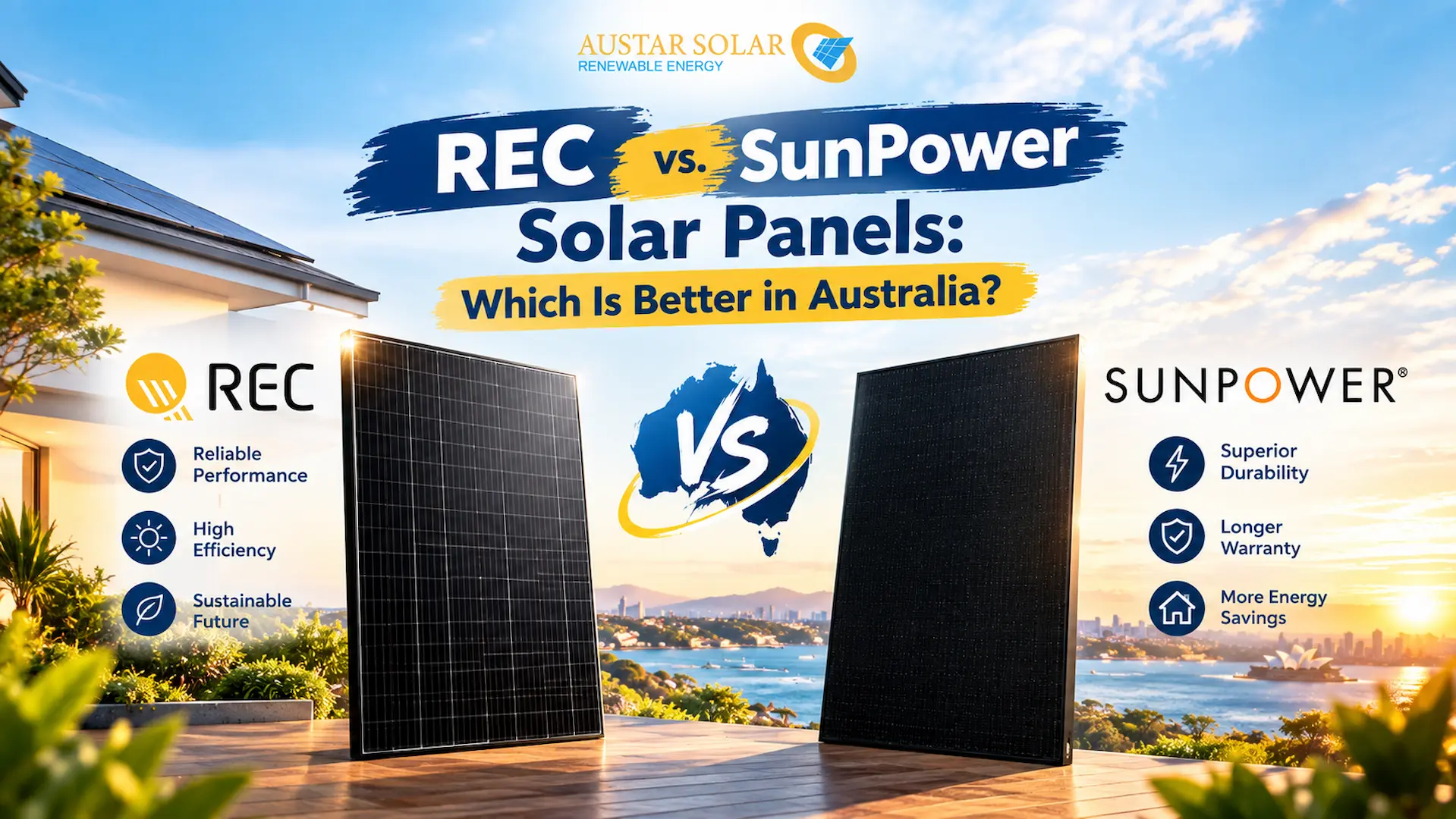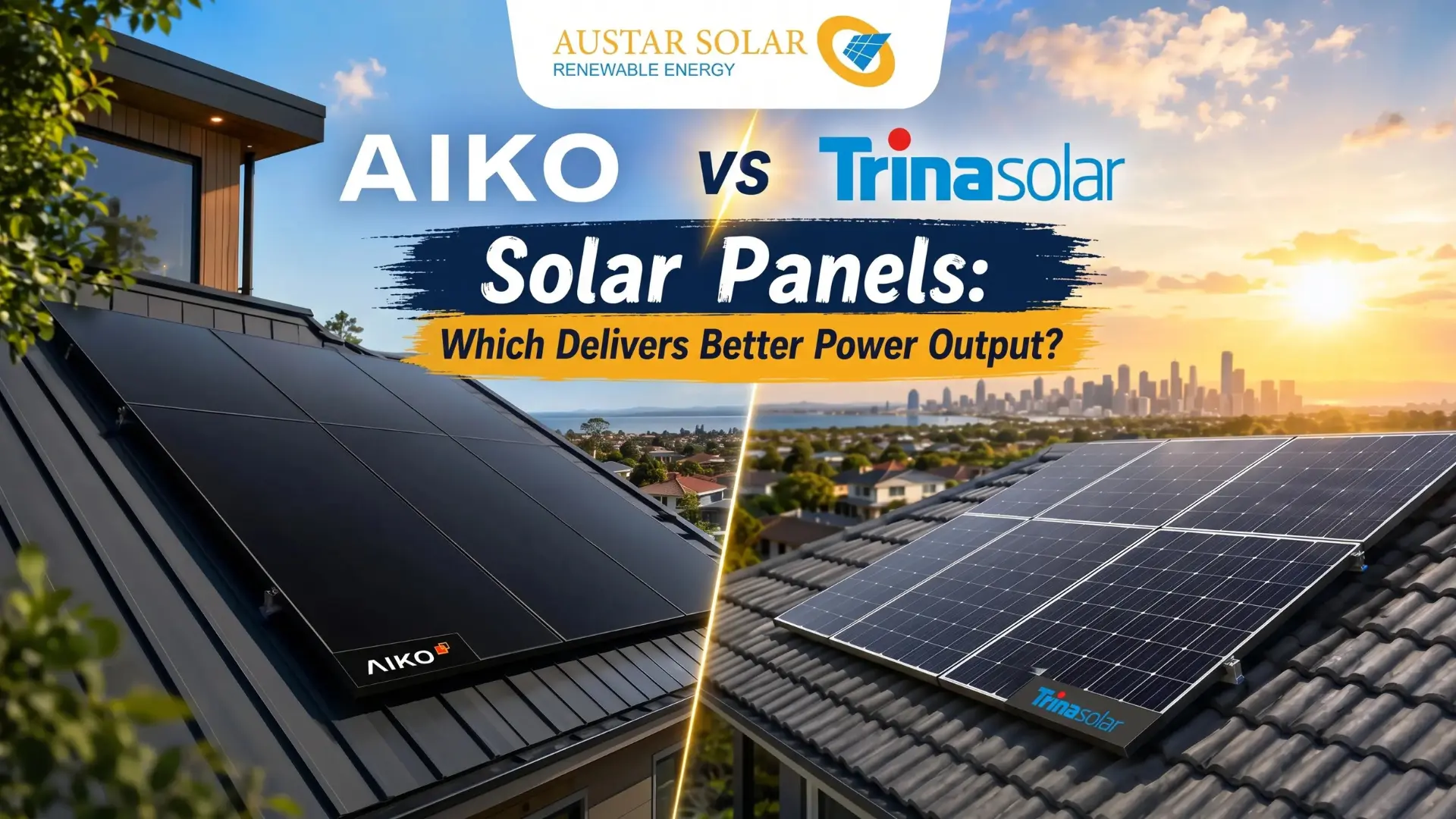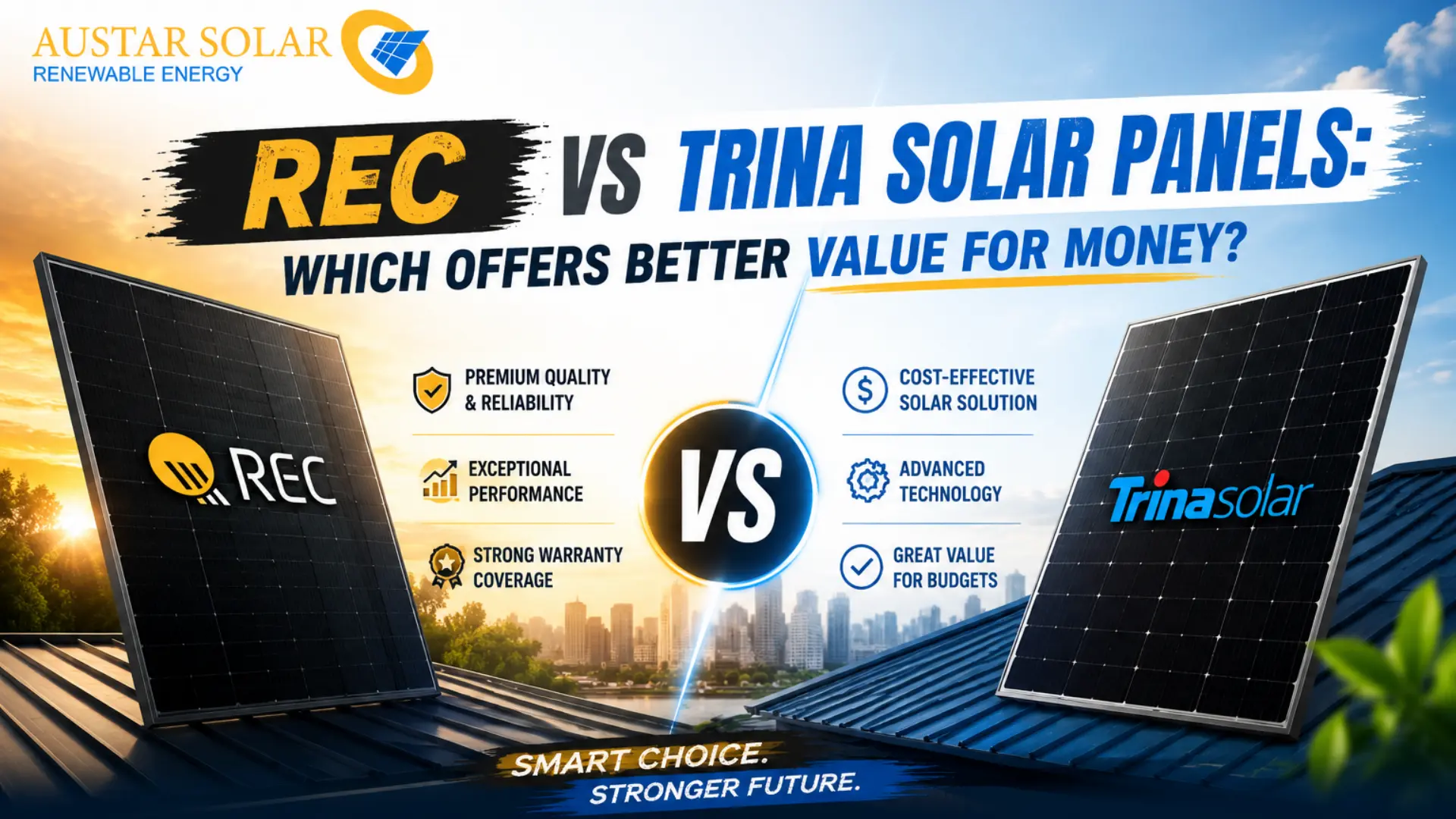
REC vs Trina Solar Panels is one of the most common comparisons for Australian homeowners looking to lower electricity bills and maximise long-term solar savings. Both brands are globally trusted and engineered to perform in Australia’s harsh climate, but they differ in efficiency, solar cell technology, warranty coverage, and overall value for money.
REC is the premium option, known for industry-leading heterojunction (HJT) efficiency and the lowest degradation rate in the market. Trina Solar has moved sharply upmarket too: its latest N-type i-TOPCon Ultra panels now rival REC on raw efficiency, backed by a 30-year performance warranty on its Vertex S+ range — while staying more affordable overall. The right choice depends on your roof size, budget, and how much you weigh long-term output versus upfront cost.
Overview of REC Solar Panels in Australia
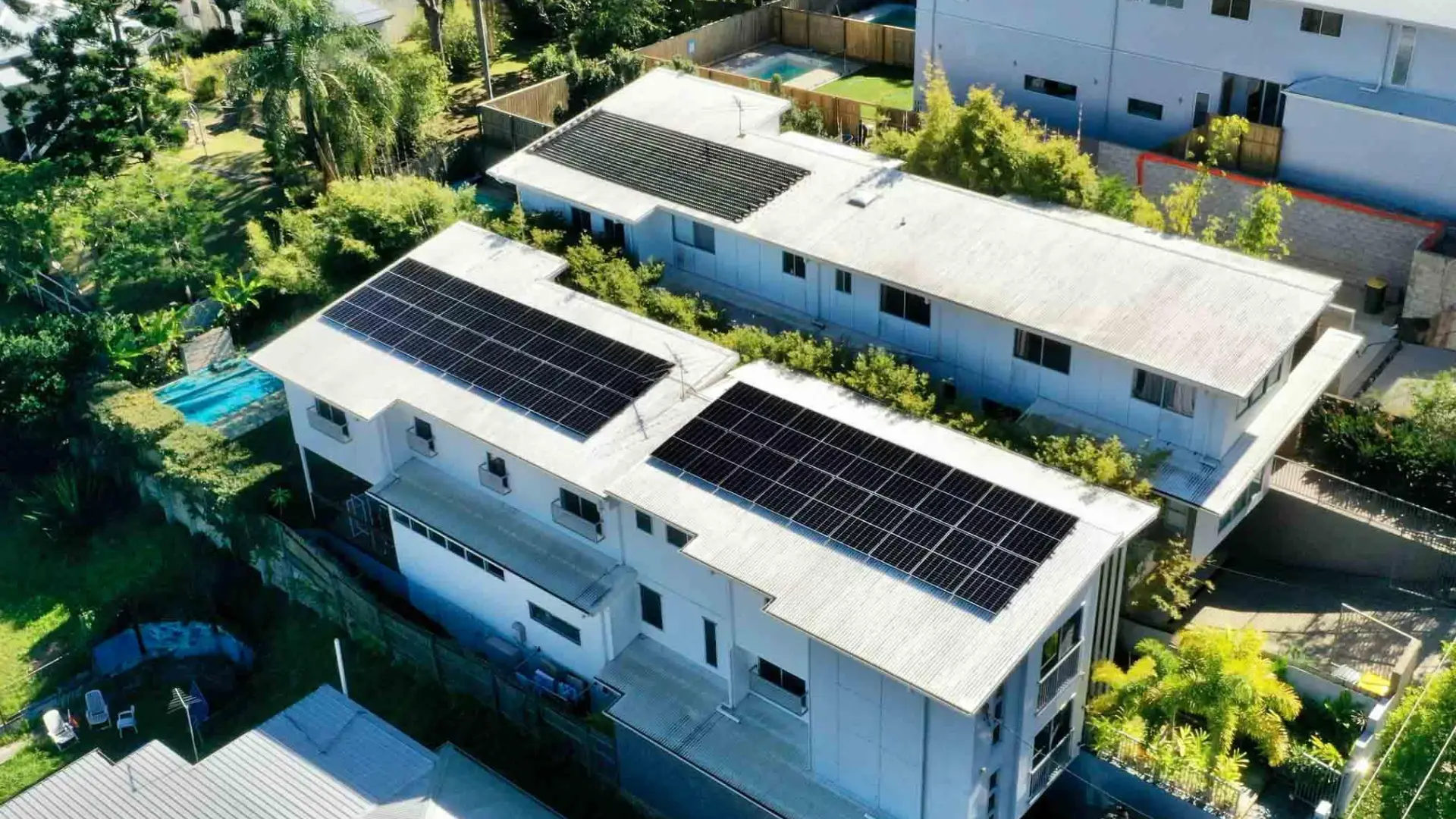
REC solar panels are a premium choice for Australian homes and businesses, built on heterojunction (HJT) cell technology that delivers high efficiency and the lowest degradation rate in the industry. REC panels handle Australia’s heat well, with an excellent temperature coefficient that limits power loss on hot days. They cost more upfront than most competitors, but their long lifespan and slow performance decline make them a strong long-term investment.
Key Features
- High efficiency (up to 22.6%) with strong energy density per panel
- Excellent temperature coefficient (-0.24%/°C) for hot Australian climates
- Industry-low annual degradation (0.25%/year after year one)
- 92% guaranteed output at year 25 — best-in-class
- Lead-free, solder-free HJT cell construction for added durability
- Manufactured in Singapore
- Suitable for residential and commercial systems
Types of REC Solar Panels
REC Alpha Pure-RX Series
- 450W–470W output
- Up to 22.6% efficiency
- HJT technology, 2.08 m² panel area
- Premium residential panel, ideal for maximising output on a given roof area
REC Alpha Pure-R Series
- 400W–430W output
- Up to 22.3% efficiency
- HJT technology, lead-free design
- Best suited to homes with limited roof space
Pros
- Produces more electricity per m² than most competitors
- Lowest degradation rate in the industry (0.25%/year)
- Strong heat performance for Australian summers
- 92% output guaranteed at year 25
- Trusted global brand with strong local support
Cons
- Higher upfront cost than most competitor brands
- Standard product warranty is only 20 years (25 years requires a REC Certified installer via ProTrust)
- Professional/certified installation is recommended to unlock full warranty terms
Overview of Trina Solar Panels in Australia
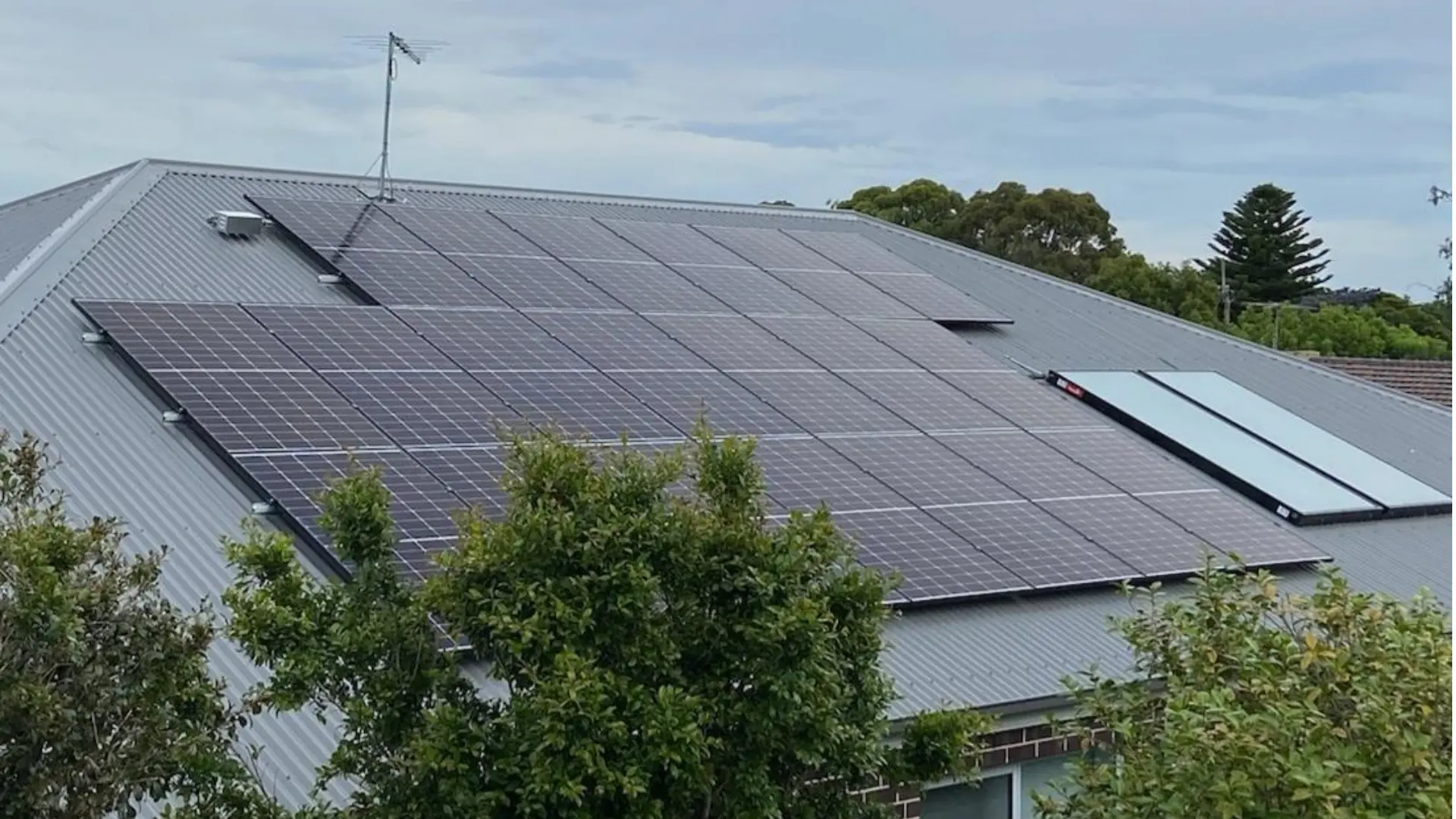
Trina Solar has shifted decisively upmarket with its Vertex S+ and Vertex N ranges, now using N-type i-TOPCon Ultra cell technology that reaches peak efficiencies of up to 24.1%, closing — and in some models exceeding — the gap with premium brands like REC. Trina backs its dual-glass N-type models with some of the strongest warranties on the market, while remaining more affordable overall than REC.
Key Features
- High efficiency, up to 24.1% on top N-type i-TOPCon Ultra models
- 30-year performance warranty on all Vertex S+ models
- Anti-soiling short-edge frame design, claimed to improve energy yield by 2%+ in dusty conditions
- Low first-year degradation (1%), then 0.4%/year thereafter
- Low-voltage design reduces balance-of-system costs
- Local Australian office (Sydney) for warranty support
Types of Trina Solar Panels (Australia, 2026)
Trina Vertex S+ Series
- 415W–525W output depending on model
- Up to 23.7% efficiency (475W model)
- Dual-glass, N-type i-TOPCon
- 30-year performance warranty on every model; product warranty ranges 15–25 years by model code
Trina Vertex N Series
- Up to 720W output (commercial-focused)
- Up to 23.2% efficiency
- N-type i-TOPCon, low-voltage design for flexible string sizing
Note: An Australia-specific Vertex S+ 515W module (NEG10R.28Z, up to 24.65% efficiency) is expected to launch in Australia in early Q3 2026 — worth revisiting this section once it’s confirmed live.
Pros
- Efficiency now competitive with premium brands (up to 24.1%)
- 30-year performance warranty on Vertex S+ — longer than REC’s standard performance warranty
- More affordable than REC overall
- Anti-soiling frame design suited to dusty regional Australian sites
- Strong local warranty support via the Sydney office
Cons
- Product warranty varies by model code (15–25 years) — must be checked per quote
- Slightly higher degradation rate than REC (0.4%/year vs 0.25%/year)
- Higher-wattage commercial panels (Vertex N) can be oversized for standard residential roofs
Technical Comparison: REC vs Trina Solar Panels
| Feature | REC Solar Panels | Trina Solar Panels |
| Panel Type | Monocrystalline HJT | Monocrystalline N-type i-TOPCon |
| Efficiency | Up to 22.6% | Up to 24.1% (Vertex N/S+ Ultra) |
| Power Output | 400W–470W | 415W–720W |
| Temperature Coefficient | -0.24%/°C | -0.29%/°C |
| First-Year Degradation | ~2% | 1% |
| Annual Degradation (Yr 2–25+) | 0.25%/year | 0.4%/year |
| Performance After 25 Years | ~92% | ~89% |
| Performance After 30 Years | N/A (25-yr warranty) | ~87.4–88.85% |
| Standard Product Warranty | 20 years | 15–25 years (model-dependent) |
| Extended Product Warranty | 25 years (via REC ProTrust) | Up to 25 years (Vertex S+ dual-glass) |
| Performance Warranty | 25 years | 30 years (Vertex S+/N) |
| Manufacturing Origin | Singapore | China |
| Local AU Support | Yes | Yes (Sydney office) |
Prefer watching instead of reading? Check out our full video review below.
Solar Panel Performance Comparison in Australia: REC vs Trina Solar Panels
REC and Trina Solar are two of the most trusted solar panel brands in Australia. Both deliver reliable performance in Australia’s sunny climate, but they suit different needs. REC focuses on premium efficiency and long-term energy production, while Trina Solar offers excellent performance at a more affordable price. Your choice depends on your budget, roof size, and long-term savings goals.
Efficiency and Energy Output
REC solar panels generally achieve higher efficiency, allowing them to produce more electricity from the same roof area. This makes them ideal for homes with limited roof space. Trina Solar panels also deliver high energy output and provide excellent value for money.
Real-life example: A homeowner in Sydney with a small 6.6kW rooftop system chooses REC panels and generates slightly more daily electricity than a similar Trina system because the roof space is limited.
Performance in Australia’s Hot Climate
Both brands are designed for Australian weather, but REC panels have a lower temperature coefficient. This means they lose less power on very hot days. Trina Solar panels also perform reliably during summer but may produce slightly less energy in extreme heat.
Real-life example: During a 40°C summer afternoon in Perth, a REC system continues producing slightly higher output than a comparable Trina installation.
Long-Term Reliability
REC’s 0.25%/year degradation remains the lowest in the industry, guaranteeing 92% output at year 25. Trina’s Vertex S+ range degrades slightly faster (0.4%/year) but is guaranteed for a longer window — 30 years — with 87.4–89% output retained at the end of that term.
Real-life example: Over 25 years, a REC system will likely retain slightly more of its original output than a Trina Vertex S+ system — but Trina’s 30-year performance warranty offers 5 extra years of guaranteed coverage that REC doesn’t match
Price & Warranty Comparison in Australia (2026)
In the Australian solar market, REC Solar serves the premium tier with high-efficiency heterojunction (HJT) technology, while Trina Solar dominates the high-value volume tier using cost-effective N-type i-TOPCon dual-glass panels. Choosing between them depends on whether your priority is maximizing long-term energy yield per square meter or minimizing upfront installation costs.
Price & Warranty of REC & Trina Solar Panels
| Comparison Feature | REC Solar Panels | Trina Solar Panels |
| Market Segment | Premium, high-end | Value, cost-effective |
| Estimated Price per Watt | AUD $0.40 to $0.50 (panels only) | AUD $0.70 to $1.00 (inclusive of basic balance of system) |
| Typical 6.6kW System Cost | AUD $8,000 – $11,500+ (fully installed) | AUD $5,000 – $7,500 (fully installed) |
| Standard Product Warranty | 20 Years | 15 to 25 Years (varies by model series) |
| Extended Product Warranty | 25 Years via REC ProTrust installers | Up to 25 Years on Vertex S+ dual-glass models |
| Performance Warranty | 25 Years | 30 Years (for Vertex S+ / dual-glass models) |
| Year 1 Degradation | Max 2% loss | Max 1% loss |
| Annual Degradation (Years 2-25+) | 0.25% (Alpha Pure series, industry-leading) | 0.40% |
| Guaranteed Output at Warranty End | 92% power remaining after 25 years | 87.4% power remaining after 30 years |
| Labor Warranty Coverage | Up to 25 years included via the ProTrust scheme | Relies primarily on the local solar installer’s warranty |
| Manufacturing Origin | Singapore | China |
| Local Australian Support | Yes, a long-standing local tech support team | Yes, the local corporate office in Sydney |
Note: Panel-only and installed system pricing varies significantly by installer, system size, and STC rebate value — recommend removing fixed AUD price ranges from this section unless verified against current Austar Solar quote data, as third-party pricing figures go stale quickly and create liability if wrong.
Which Solar Panel Brand Is More Efficient in Australia? REC vs Trina Solar Panels
If efficiency is your top priority, REC solar panels are generally more efficient than Trina solar panels in Australia. REC’s premium models reach around 22.6% efficiency, while most Trina residential panels offer around 24.1% efficiency, depending on the series.
REC Solar Panel Efficiency
REC is known for high-performance premium panels. Its latest Alpha Pure-RX and Alpha Pure 2 series use advanced cell technology to produce more electricity from the same roof space. These panels also have lower annual performance loss, helping maintain higher energy output over time. REC is a better choice for homes with limited roof space where every panel needs to generate maximum power.
Trina Solar Panel Efficiency
Trina offers excellent efficiency for its price. The Vertex S+ series provides strong performance with modern N-Type technology and high power ratings. While slightly behind REC in peak efficiency, Trina panels deliver reliable energy production and good value for Australian households.
Which Brand Should You Choose?
Choose REC if you:
- Need the highest efficiency.
- Have a small roof.
- Want maximum long-term energy output.
Choose Trina if you:
- Want excellent performance at a lower cost.
- Have enough roof space.
- Need the best value for money.
Overall, REC wins on efficiency, while Trina offers the better balance of performance and affordability for most Australian homes.
Conclusion
Both REC and Trina solar panels are excellent choices for Australian homes and businesses. REC is the better option if you want premium quality, higher efficiency, lower degradation, and the best long-term energy output.
Trina is a smart choice if you want reliable performance, modern technology, and better value at a lower price. Your final decision should depend on your budget, available roof space, and energy needs.
If long-term performance is your priority, REC is worth the higher investment. If you want to reduce installation costs while still getting dependable solar performance, Trina offers outstanding value for money in Australia.
FAQs on REC and Trina solar panels
Do REC and Trina panels work well in hot weather?
Yes. Both brands perform well in Australia’s hot climate. REC panels usually have a slightly better temperature coefficient, helping maintain higher performance during very hot days.
Which brand has the better warranty?
It depends on the term. REC’s standard product warranty is 20 years (25 with a certified ProTrust installer). Trina’s Vertex S+ range offers up to 25 years’ product warranty and a 30-year performance warranty — longer than REC’s 25-year performance warranty.
Are Trina solar panels reliable?
Yes. Trina is one of the world’s leading solar manufacturers. Its panels are known for dependable performance, good durability, and excellent value for Australian homes.
Which brand is better for small roofs?
REC is usually the better choice for small roofs. Its higher-efficiency panels generate more electricity from limited roof space, helping maximise energy production.
Which brand offers better value for money?
Trina, particularly its Vertex S+ range — it now matches or exceeds REC on peak efficiency, offers a longer performance warranty, and costs less overall.