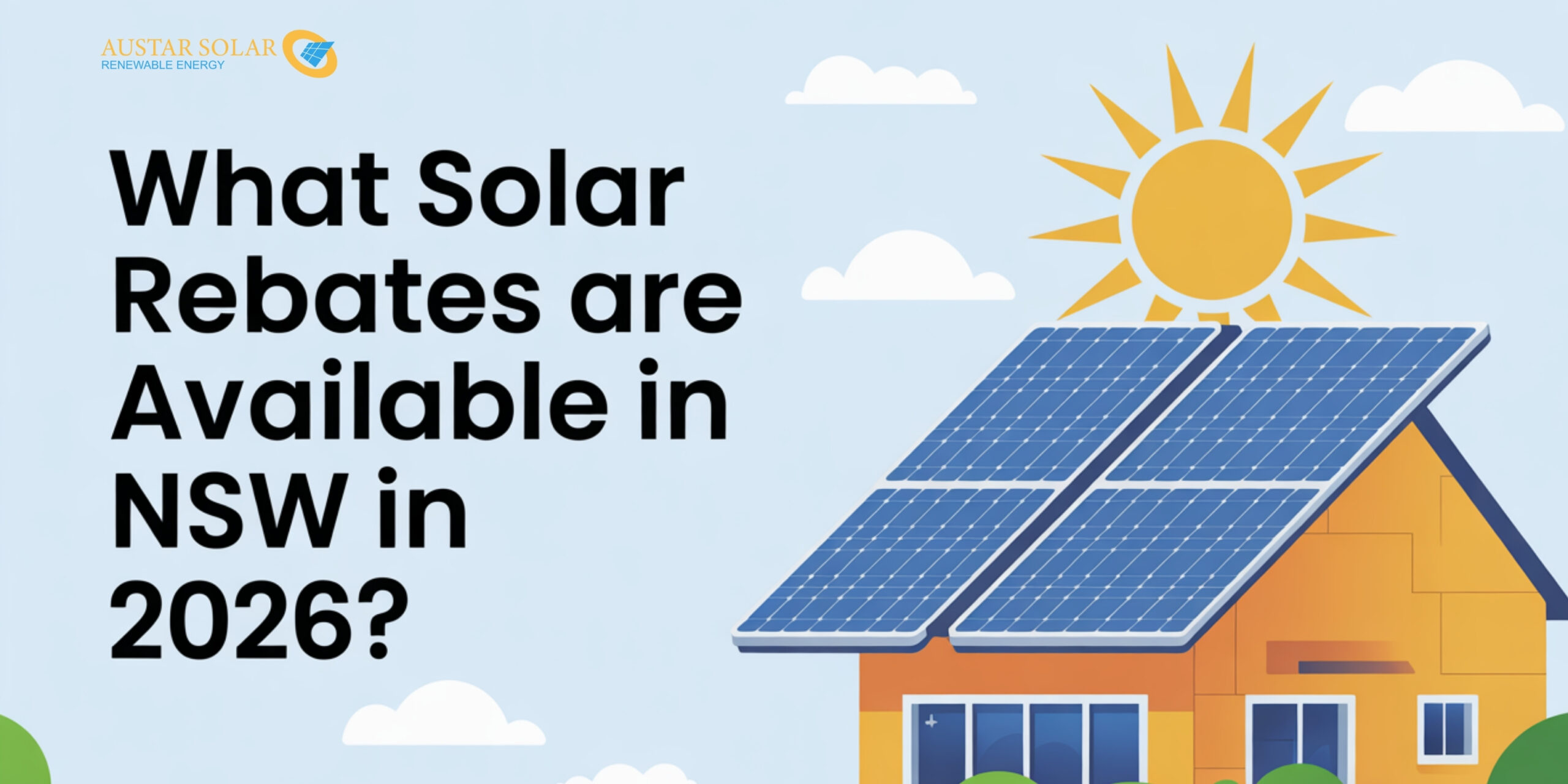
As Australia continues its transition toward renewable energy, New South Wales homeowners and businesses are increasingly turning to solar power to reduce electricity costs and environmental impact. Understanding what solar rebates are available in NSW in 2026 is crucial for anyone considering making the switch to clean energy.
In 2026, most upfront solar panel rebates available in NSW are delivered through federal programs, while NSW state incentives are primarily focused on battery storage and peak demand reduction, rather than direct solar panel rebates. These incentives can significantly reduce upfront costs when applied correctly. This guide explains the accurate, currently available solar rebates in NSW in 2026, eligibility requirements, and how to maximise your savings while remaining compliant with government guidelines.
Quick Summary of NSW Solar Rebates in 2026
| Program | Potential Savings |
| Small-Scale Technology Certificates (STCs) | $1,800 – $5,000+ |
| Cheaper Home Batteries Program | Varies by battery size |
| Solar for Apartment Residents (SoAR) | Up to $150,000 grant |
| Virtual Power Plant (VPP) Incentive | $550 – $1,500 |
| Heat Pump Water Heater Rebate | $190 – $670 |
| Solar Feed-in Tariffs | Ongoing annual savings |
Federal Solar Rebates Available in NSW
1. Small-Scale Technology Certificates (STCs)
The primary solar rebate available to NSW residents in 2026 is the Small-Scale Technology Certificates (STCs) scheme, administered under the federal Small-scale Renewable Energy Scheme (SRES).
When you install an eligible solar PV system, STCs are created based on the amount of renewable electricity your system is expected to generate over its lifetime. These certificates are typically calculated using a deeming period that gradually reduces each year as part of the scheme’s scheduled phase-down toward 2030.
The number of STCs generated depends on:
- System size
- Installation location (solar zone)
- Installation year
NSW locations generally fall within Zone 3 or Zone 4, which receive good solar exposure.
In 2026, a typical 6.6kW solar system installed in Sydney is expected to generate approximately 46 STCs, depending on the exact installation date and location. With STC market prices commonly ranging between $35–$40 per certificate, this usually results in an upfront discount of approximately $1,800–$1,900.
Most installers apply this rebate as a point-of-sale discount by purchasing the STCs on your behalf, reducing the upfront system cost immediately.
How STC Values Are Calculated
STC values fluctuate based on market supply and demand, as well as the scheme’s annual step-down. Each year, the number of STCs a system can create decreases slightly, meaning rebate values reduce over time. For this reason, installing solar sooner generally provides better rebate outcomes.
The number of Small-scale Technology Certificates (STCs) for a solar system is calculated using this formula:
Number of STCs = Postcode Zone Rating × Deemed Period (years remaining until 2030) × System Size (kW).
To estimate the total STC rebate, you simply multiply the number of STCs by the current price of each certificate:
STC Rebate = Total STCs × Price per STC.
For example, if you install a 6.6kW solar system in Sydney (Zone 3), the zone rating is 1.382, and the remaining deeming period is 5 years (2026-2030). Using the formula: 1.382 × 5 × 6.6 = approximately 46 STCs.
If the current market value of one STC is $40, the estimated rebate would be: 46 × $40 = $1,840.
So, a 6.6kW solar system in Sydney could receive around $1,840 in STC rebates, which helps reduce the upfront cost of installing solar panels.
| Solar Zone 3 (Average Sunlight) Solar Zone factor of 1.382 | |||
| System size | Amount of STC’s | STC Price | STC Incentive |
| 8.8 kW | 61 | $40 | $2,440 |
| 10.56 kW | 73 | $40 | $2,920 |
| 13.2 kW | 91 | $40 | $3640 |
| 19.3 kW | 133 | $40 | $5,320 |
The Clean Energy Regulator (CER) oversees the STC scheme and sets the regulatory framework, while pricing is determined by the open certificate market. For detailed STC calculation, visit here]
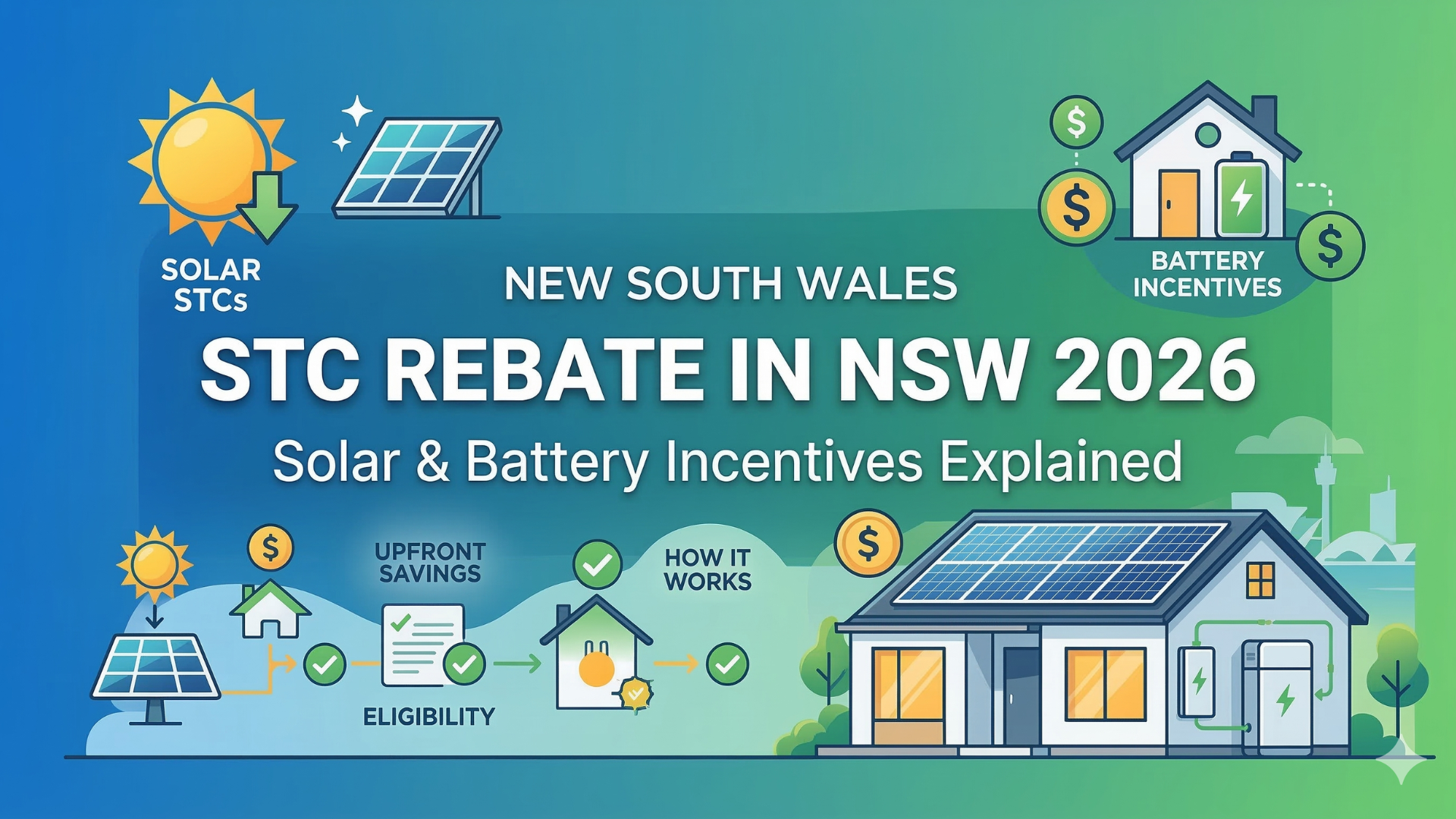
2. Cheaper Home Batteries Rebate
The total amount of purchase & installation of rooftop solar and energy-efficient home appliances like solar hot water systems, heat pump water heaters, etc., under the Federal Government’s Small-Scale Renewable Energy Scheme can claim around 30 to 70% of the total cost. The savings from the STC Rebate can vary significantly depending on several factors.
From 1 July 2025, the Australian Government introduced the Cheaper Home Batteries Program. From January – April 2026, the rebate value is $336 per usable kWh of battery capacity, and from May – December 2026, this value will be $272 per usable kWh of battery capacity. It gradually decreases each year. Here is an overview of the changes to the Federal Cheaper Home Batteries Rebate in Australia after 1 May 2026 :
| Year From | Period of time | STC Factor (Before Change) | Proposed STC Factor (Already Executed) | Price per STC | Total STC Rebate (per usable kWh) = STC Factor × Price per STC |
| 2026 | Jan – Apr | 8.4 | 8.4 | $40 | $336 |
| 2026 | May – Dec | 8.4 | 6.8 | $40 | $272 |
| 2027 | Jan – Jun | 7.4 | 5.7 | $40 | $228 |
| 2027 | Jul – Dec | 7.4 | 5.2 | $40 | $208 |
| 2028 | Jan – Jun | 6.5 | 4.6 | $40 | $184 |
| 2028 | Jul – Dec | 6.5 | 4.1 | $40 | $164 |
| 2029 | Jan – Jun | 5.6 | 3.6 | $40 | $144 |
| 2029 | Jul – Dec | 5.6 | 3.1 | $40 | $124 |
| 2030 | Jul – Dec | 4.7 | 2.6 | $40 | $104 |
| 2030 | Jul – Dec | 4.7 | 2.1 | $40 | $84 |
Factors to be considered regarding battery size
Small battery sizes from 0 – 14 kWh capacity: (100% STC rebate)
Medium battery sizes from 14 – 28 kWh capacity: (60% STC rebate)
Large battery sizes from 28 – 50 kWh capacity: (15% STC rebate)
Note*: All these percentages refer to the proportion of the standard STC rebate entitlement, not the total battery cost.
For example: A 30 kWh battery, the STC rebate will be
- For the first 14 kWh, a 100% rebate will be calculated: (14 x 6.8 x 100%) = 95.2 STC points.
- For the next 14 kWh, a 60% rebate will be calculated: (14 x 6.8 x 60%) = 57.12 STC points.
- For the remaining 2 kWh, a 15% rebate will be calculated: (14 x 6.8 x 15%) = 2.04 STC points
Total Estimated STC Rebate
95.2+57.12+2.04=154.36 STC points
If 1 STC point = $40,
Then the total STC rebate will be: (154.36 x 40) = ~ $6174.4 rebate.
To qualify
- The battery must be 5 – 50 kWh capacity.
- It must be installed with solar panels (existing or new).
- Installation must be done by an accredited installer with approved products.
NSW State Government Solar & Battery Incentives (2026)
1. Solar for Apartment Residents (SoAR) Grant Program
The Solar for Apartment Residents (SoAR) Grant Program from the NSW Government helps apartment buildings install rooftop solar systems. Under this program, the government covers up to 50% of the total cost of installing a solar photovoltaic (PV) system, with a maximum grant of $150,000 per apartment complex.
This initiative is designed to help apartment residents, including renters, access the benefits of solar energy. By installing shared solar systems, residents can reduce electricity bills and lower greenhouse gas emissions, while also supporting the transition to cleaner energy across New South Wales.
Example: If an apartment building installs a 100 kW solar system costing $200,000:
- Government grant = $100,000
- Building owners pay the remaining $100,000
Eligibility
- An apartment building must have 3 or more units
- The owners’ corporation must approve the project
- System installed by an accredited provider
2. Battery Incentive for Virtual Power Plants (VPP) – Energy Savings Scheme NSW
Homeowners in NSW can receive a battery incentive of approximately $550 to $1,500 when connecting a 10 kWh to 27 kWh battery energy storage system to a Virtual Power Plant (VPP) under the Energy Savings Scheme (ESS).
This incentive can be claimed twice within three years, providing additional value for households adopting battery storage. A VPP links multiple home batteries together so they can share stored electricity with the grid when demand is high.
Participating in a VPP allows households to sell excess stored energy, earn extra savings, and contribute to NSW’s climate goals of reducing emissions by 70% by 2035 and achieving net-zero emissions by 2050.
Example: If a homeowner installs a 13.5 kWh battery costing $13,000:
- VPP incentive ≈ $742
- New battery cost ≈ $12,258
Eligibility
- Battery must be VPP-compatible
- Installed by an accredited installer
- Must join an approved VPP provider
- System connected to the grid in NSW
3. Heat Pump Water Heater Rebate (ESS Incentive)
Under the Energy Savings Scheme (ESS), NSW residents and businesses can also receive an incentive of $190 to $670 when upgrading to an energy-efficient heat pump water heater (HPWH).
Heat pump water heaters use significantly less electricity compared to traditional electric water heaters, making them a more reliable and cost-effective option in the long term. Installing these systems can lower household energy bills, reduce electricity consumption, and support NSW’s pathway to net-zero emissions by 2050.
Benefits
- Lower electricity usage
- Reduced greenhouse gas emissions
- Lower long-term energy bills
Eligibility
- Existing water heater replaced with an approved heat pump
- Installed by an accredited provider
- Property located in NSW
4. Solar Feed-in Tariffs in NSW
In addition to rebates and incentives, solar system owners can earn credits through feed-in tariffs by exporting unused solar electricity to the grid. Feed-in tariff rates vary depending on the electricity retailer and energy plan.
As of 2026 in NSW, most feed-in tariff rates range between 5 and 15 cents per kilowatt-hour (kWh). These payments allow solar households to earn back some of their electricity costs by selling excess solar energy generated during the day.
Typical rates offered by electricity retailers: 5 – 15 cents per kWh
The exact rate depends on:
- Electricity retailer
- Energy plan
- Time-of-day export tariffs
Example
If a 6.6 kW solar system exports 10 kWh per day:
- At 10 c/kWh FiT
- Annual earnings ≈ $365
Regional and Council-Specific Rebates
Sydney Metro Council Initiatives
Some local councils across NSW may offer small-scale sustainability rebates or support programs that can apply to solar installations. These programs are:
- Location-specific
- Limited in value
- Subject to change or funding availability
Rebate values, where available, are typically modest and not guaranteed.
Regional NSW Support Programs
Regional NSW residents may occasionally have access to renewable energy grants through regional development programs or community energy initiatives. Availability varies widely by region and should be confirmed directly with local councils or regional development authorities.
Eligibility Requirements for NSW Solar Rebates
General Eligibility Criteria
To qualify for solar rebates in NSW:
- Systems must be installed by a Clean Energy Council (CEC) accredited installer
- Approved components meeting Australian standards must be used
- Systems must be new and compliant with electrical and building regulations
- STCs apply to residential and small commercial properties
Property Requirements
Properties must have suitable roof space, structural integrity, and reasonable solar access. Heavy shading or unsuitable roof orientation may reduce system performance and rebate value.
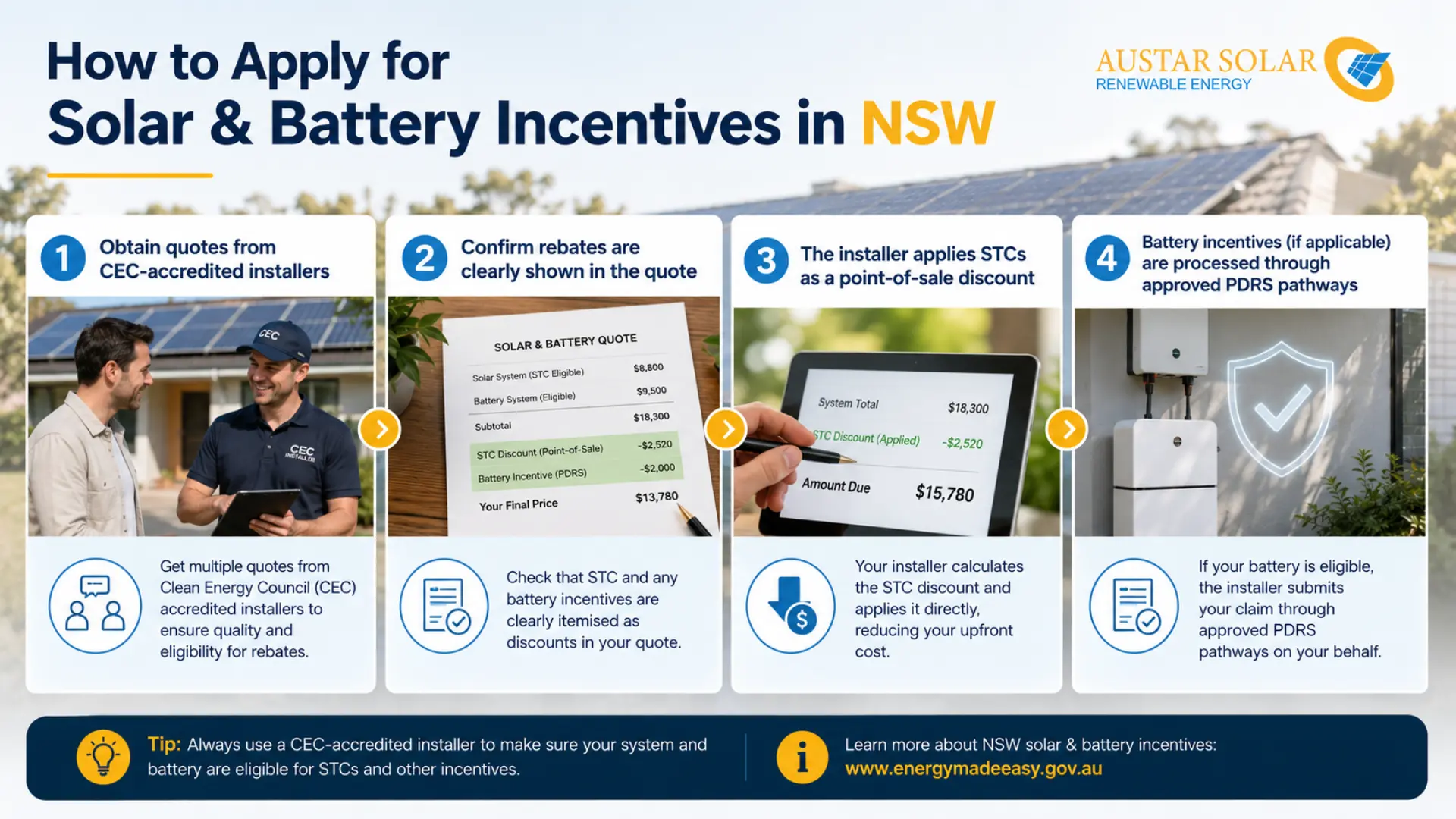
How to Apply for Solar & Battery Incentives in NSW
Most homeowners experience a simple application process, as installers typically manage STC claims on your behalf.
General process:
- Obtain quotes from CEC-accredited installers
- Confirm rebates are clearly shown in the quote
- The installer applies STCs as a point-of-sale discount
- Battery incentives (if applicable) are processed through approved PDRS pathways
Long-Term Benefits Beyond Rebates
Feed-in Tariffs
NSW solar owners can earn ongoing savings through feed-in tariffs paid for excess electricity exported to the grid. Rates vary by retailer and plan, typically ranging between 5 and 15 cents per kWh.
Increased Property Value
Homes with solar systems are often more attractive to buyers due to lower ongoing energy costs and sustainability benefits, potentially increasing resale value.
Frequently Asked Questions about the NSW solar rebate
How much can I save with solar rebates in NSW in 2026?
The total savings depend on your system size and which programs you qualify for, but typical NSW homeowners can reduce upfront costs by $3,000-$6,000 through federal STCs alone, with additional state and local incentives potentially adding another $2,000-$4,000. Combined with long-term electricity bill savings averaging $1,500-$2,500 annually, most systems pay for themselves within 3-6 years.
Are solar rebates reducing in 2026?
Yes, the federal STC scheme continues its scheduled phase-down, with rebate values approximately 7% lower than in 2025. However, substantial incentives remain available, and installing in 2026 still captures significant value before further reductions in subsequent years.
Can renters access solar rebates in NSW?
Renters typically cannot access solar rebates, as most programs require property ownership. However, some social housing and low-income programs may assist eligible renters with landlord cooperation. The best approach is to check specific program requirements or discuss solar options with your landlord.
Do I need to pay tax on solar rebates?
Solar rebates and incentives are generally not considered taxable income for residential installations. However, feed-in tariff payments may have tax implications for large systems. Consulting with a tax professional ensures compliance with current Australian Taxation Office guidelines regarding renewable energy income.
Conclusion
In 2026, solar rebates in NSW are primarily delivered through federal STCs, with state incentives focused on battery storage and peak demand reduction rather than direct solar panel rebates. By understanding which programs are active, avoiding outdated incentives, and working with accredited installers, NSW residents can confidently invest in solar while maximising savings.
With electricity prices continuing to rise and rebates gradually stepping down, installing solar in 2026 remains a smart and future-focused decision.