Choosing between Aiko vs Trina solar panels depends on efficiency, power output, roof space, and long-term performance. Both brands offer advanced N-type solar technology for Australian homes. AIKO panels focus on high power density and strong energy generation from smaller roof areas. Trina panels offer high efficiency, reliable performance, and several residential panel options.
For Australian homeowners, panel efficiency is important because roof space can limit system size. Temperature performance and degradation rates also matter in Australia’s hot climate. Warranty coverage can also affect long-term value.
In this guide, we compare AIKO and Trina solar panels across efficiency, wattage, technology, warranties, and performance. We also explain which panel can deliver better value for different Australian homes and roof conditions.
Overview of AIKO Solar Panels in Australia
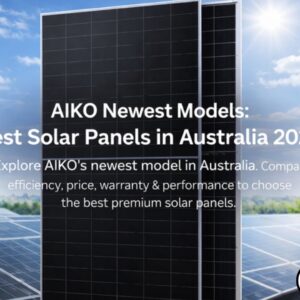
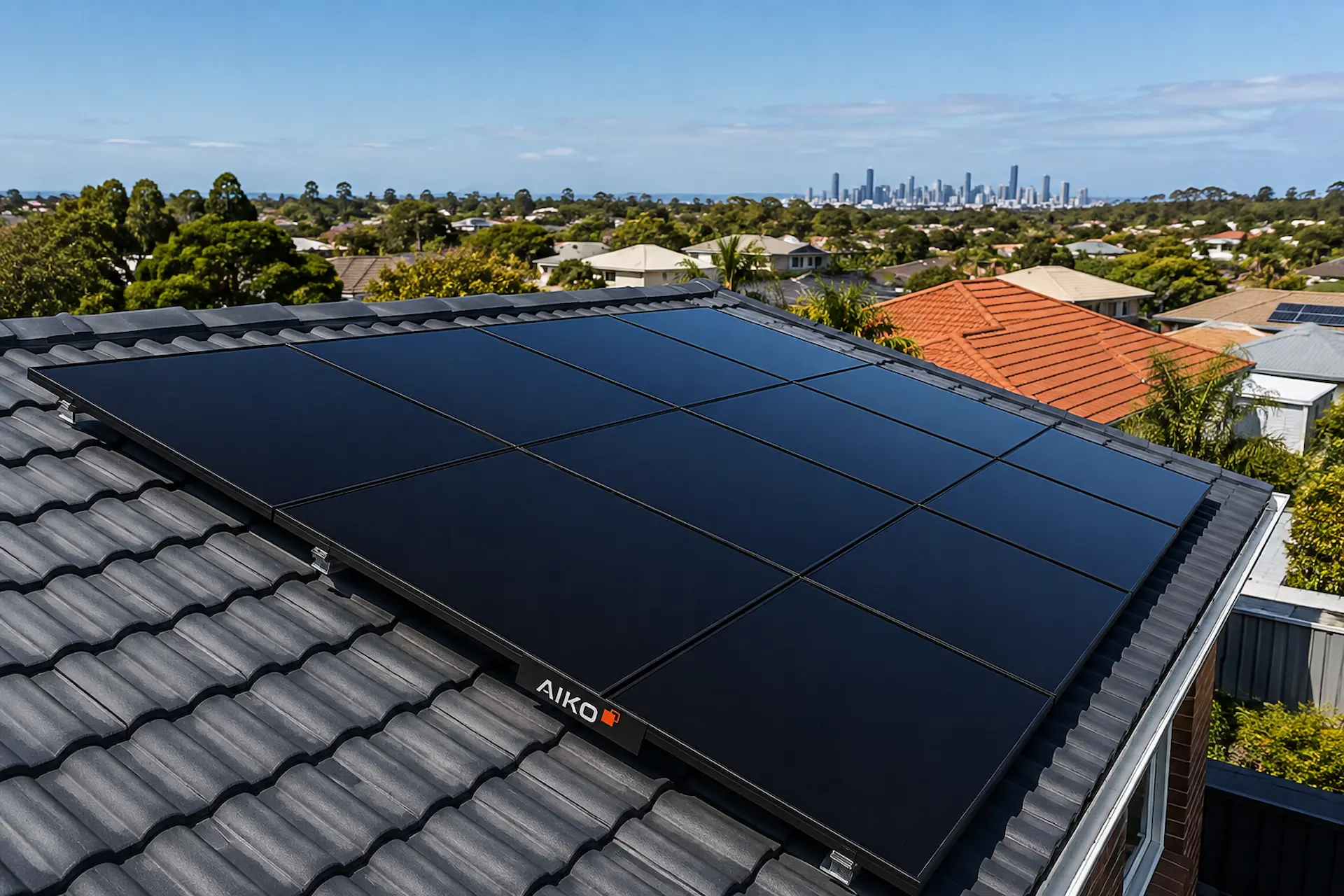
AIKO is a major solar panel manufacturer with a strong focus on high-efficiency N-type ABC cell technology. Its Australian range includes the Neostar 3P54, Neostar 3P+54, and Neostar 3S54 series. These panels target homes where roof space is limited and higher output per panel matters.
Key Features
- Up to 25.0% efficiency: The Neostar 3P54 reaches 500W output and 25.0% module efficiency.
- N-type ABC cells: AIKO uses All Back Contact technology to improve power output and module efficiency.
- High power options: Current Neostar models reach up to 550W in the 60-cell format.
- Low degradation: The Neostar 3P54 specifies no more than 1% first-year degradation and 0.35% annual degradation from years two to 30.
- Strong temperature performance: The Neostar 3P54 has a power temperature coefficient of -0.26% per °C, which helps limit output losses as panel temperature rises.
- Partial shading optimisation: AIKO lists shading optimisation as a key feature across its Australian Neostar range.
- Long performance warranty: Selected Neostar models include a 30-year linear performance warranty.
How AIKO Solar Panels Work
- Sunlight reaches the panel’s photovoltaic cells.
- ABC cells convert sunlight into direct-current electricity.
- An inverter converts it into usable household electricity.
- Your home uses the generated electricity first.
- Excess electricity can charge a compatible battery or export to the grid.
Pros
- Up to 25.0% efficiency
- High power output from compact residential panels
- Low degradation rate
- Strong temperature performance
- Partial-shading optimisation
- Long performance warranty
Cons
- Premium technology can cost more than basic panels
- Actual output depends on roof direction, shading, temperature, and installation quality
- High-efficiency panels do not remove the need for correct system sizing
Best For
AIKO panels suit Australian homes with limited roof space, high electricity demand, or a focus on maximum panel efficiency. The exact model should match your roof size, inverter, and installation conditions.
Overview of Trina Solar Panels in Australia
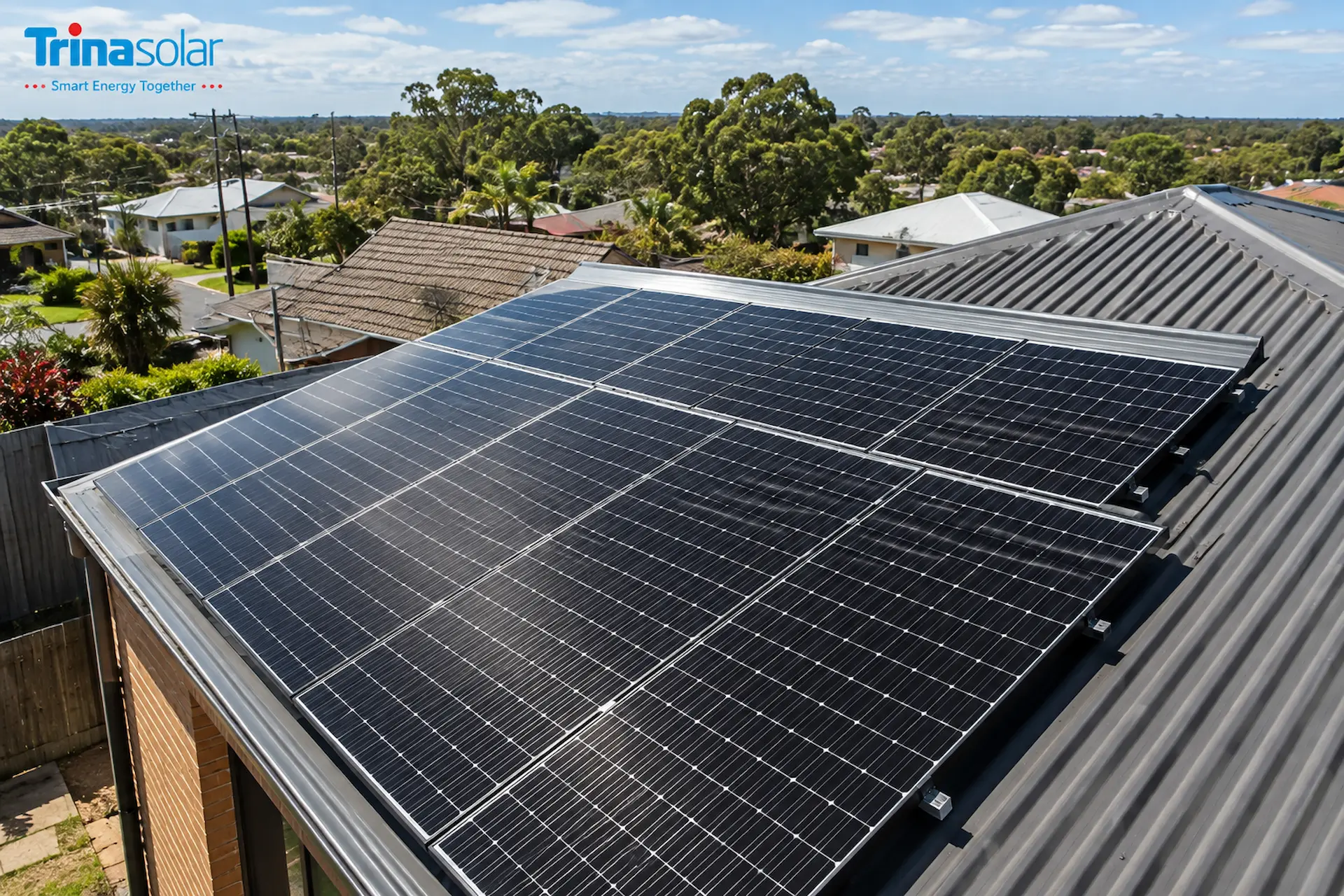
Trina Solar is a Tier 1, ASX-listed Chinese manufacturer active in Australia, supplying residential, commercial, and utility-scale projects. Its Australian range centers on n-type TOPCon technology (Vertex N, Vertex S+) plus older p-type panels (Vertex, Vertex S), with maximum power output reaching 760W using i-TOPCon Ultra cell technology.
Key Features
- High efficiency: The Australia-exclusive Vertex S+ G3 reaches 24.7% module efficiency.
- N-type i-TOPCon: This cell technology improves conversion efficiency and supports long-term performance.
- Dual-glass design: The 1.6+1.6 mm construction provides durability for Australian rooftop conditions.
- High power output: The latest G3 model produces up to 515W within a standard 1.842 m × 1.134 m footprint.
- Low temperature coefficient: The G3 has a -0.26%/°C temperature coefficient, helping reduce heat-related output losses.
- Weather resistance: The G3 supports up to 5400 Pa snow load and 4000 Pa wind load.
- Warranty: Vertex S+ models include up to a 25-year product warranty and 30-year power warranty.
How Trina Solar Panels Work
- Sunlight reaches the photovoltaic cells.
- The cells convert sunlight into direct-current electricity.
- An inverter converts this electricity into usable household power.
- Your home uses the generated electricity first.
- Extra power can charge a compatible battery or flow to the grid.
Pros
- High efficiency and power output
- Advanced N-type i-TOPCon technology
- Strong heat performance
- Durable dual-glass construction
- Long warranty coverage
- Australian-specific high-efficiency option
Cons
- Premium models can cost more than basic panels
- Actual generation depends on roof direction, shading, and installation
- Higher wattage does not automatically mean better value for every roof
Available Trina Solar Panel Series in Australia
Based on Trinasolar’s Australia site, here are the available solar panel (PV module) series:
| Series | Type | Positioning / Use Case | Key Highlights |
| Vertex N | n-type (TOPCon) | All scenarios – utility-scale, C&I, residential | Maximum power output up to 760W, using i-TOPCon Ultra cell technology; part of the TOPCon 3.0 era. World-record 26.58% cell efficiency; ≤1% first-year degradation, 0.4% annual degradation thereafter |
| Vertex S+ | n-type (TOPCon) | Premium residential and C&I (commercial & industrial) | Compact high-efficiency panel; used in Australian projects such as a 722.4kW carport in Victoria (Vertex S+ Clear Black modules) and a 202kW multi-site C&I project in Playford, South Australia, using 500W Vertex S+ modules |
Technical Comparison: Aiko vs Trina solar panels
Here’s a technical comparison of the flagship residential lines from each brand — AIKO’s Neostar 2S/2S+ (N-type ABC back-contact) versus Trina’s Vertex S+ (N-type TOPCon):
| Spec | AIKO Neostar 2S / 2S+ | Trina Vertex S+ (NEG9R.28) |
| Cell technology | N-type ABC (All Back Contact) | N-type TOPCon |
| Power range | 440W–470W (54-cell version), up to 500W-520W on the 60-cell dual-glass version | 440W–475W |
| Module efficiency | Up to 23.6% | Up to 23.8% |
| Temperature coefficient (Pmax) | -0.26%/°C | -0.29%/°C (older gen was -0.30%/°C) |
| First-year degradation | ≤1% in the first year | Maximum 1% degradation in first year |
| Annual degradation (yr 2+) | ≤0.35%/year in the following years | 0.4% each year thereafter |
| Front glass thickness | 3.2 mm (mono-glass version) | 1.6 mm (dual-glass) |
| Cell count | 108 cells | 96 N-type i-TOPCon monocrystalline cells |
| Dimensions | 1757 x 1134 x 30 mm | 1762 x 1134 x 30 mm |
| Weight | ~21.5 kg | 21 kg |
| Product warranty | 25-year product warranty | 25 years |
| Performance warranty | 30-year performance warranty | 30 years (guarantees minimum output after 30-year linear degradation) |
| Max system voltage | Typically 1500V DC | 1500V DC |
Solar Panel Performance Comparison in Australia
AIKO and Trina are both strong solar panel choices for Australian homes. AIKO has the edge in maximum efficiency, while Trina offers strong output, durability, and a long track record in Australia. Independent 2026 installer voting placed AIKO first and Trina among the top five brands.
Performance Comparison
| Feature | AIKO | Trina Solar |
| Maximum efficiency | Up to 25.0% | Up to 24.7% |
| Cell technology | ABC | N-type i-TOPCon |
| Main strength | High efficiency | Proven reliability |
| Best for | Limited roof space | Balanced performance |
| Heat performance | Strong | Strong |
| Warranty | Up to 30 years | Up to 30 years |
Real-Life Experience
Australian AIKO customers report strong generation in cloudy weather and during winter. One NSW owner reported around 30 kWh daily production from 26 × 500W AIKO panels on a sunny winter day.
Trina also has strong customer feedback. Solar Choice shows 4.67/5 from 212 Australian Trina reviews, with many customers reporting satisfactory output.
Customer Feedback
- AIKO: Customers often praise efficiency, appearance, and low-light performance.
- Trina: Customers commonly report reliable output and good overall performance.
Which Is More Efficient in Australia: Aiko vs Trina solar panels
For efficiency, AIKO currently has a slight edge over Trina Solar. AIKO’s latest Neostar 3S+ panels reach 24.4% efficiency and 540W output. Trina’s new Australian-exclusive Vertex S+ G3 reaches 24.7% efficiency and 515W output.
| Feature | AIKO Neostar 3S+ | Trina Vertex S+ G3 |
| Maximum efficiency | 24.4% | 24.7% |
| Maximum output | 540W | 515W |
| Cell technology | N-type ABC | N-type i-TOPCon |
| Best advantage | High power density | Higher efficiency |
Which Should Australian Homes Choose?
- Trina is better when roof space is limited, and efficiency matters most.
- AIKO offers higher maximum wattage on its Neostar 3S+ range.
- Both use advanced N-type cell technology.
- Both suit Australia’s hot and demanding climate.
- Trina offers a 25-year product warranty and 30-year power warranty on its Vertex S+ range.
Conclusion
Choosing between Aiko and Trina solar panels depends on your roof space, energy needs, and budget. AIKO is a strong option for homeowners who want high power output and excellent space efficiency. Trina is also a reliable choice with high efficiency and proven solar technology. Both brands offer advanced N-type panels designed for strong long-term performance.
For smaller roofs, AIKO can provide more power from limited space. Trina may be a better fit if you prefer a well-established solar brand with strong residential options. Before buying, compare panel efficiency, warranty terms, degradation rates, and installer quality.
A professional assessment by Austar Solar can help you select the better panel for your Australian home.
FAQs on AIKO vs Trina solar panel
Which panel produces more power, AIKO or Trina?
AIKO can offer higher wattage on some models. However, actual energy production depends on panel efficiency, installation angle, shading, and local weather conditions.
Which is better for a small roof?
AIKO can be a strong choice for smaller roofs. Its high power density can help produce more electricity from limited roof space.
Can AIKO and Trina panels work with the same inverter?
Generally, panels from both brands can work with suitable inverters. The inverter must match the panel’s voltage, current, and system requirements.
Is AIKO better than Trina for Australian solar?
Neither brand is best for every home. AIKO can have an advantage in power density, while Trina offers highly efficient panels and a long-established market presence.