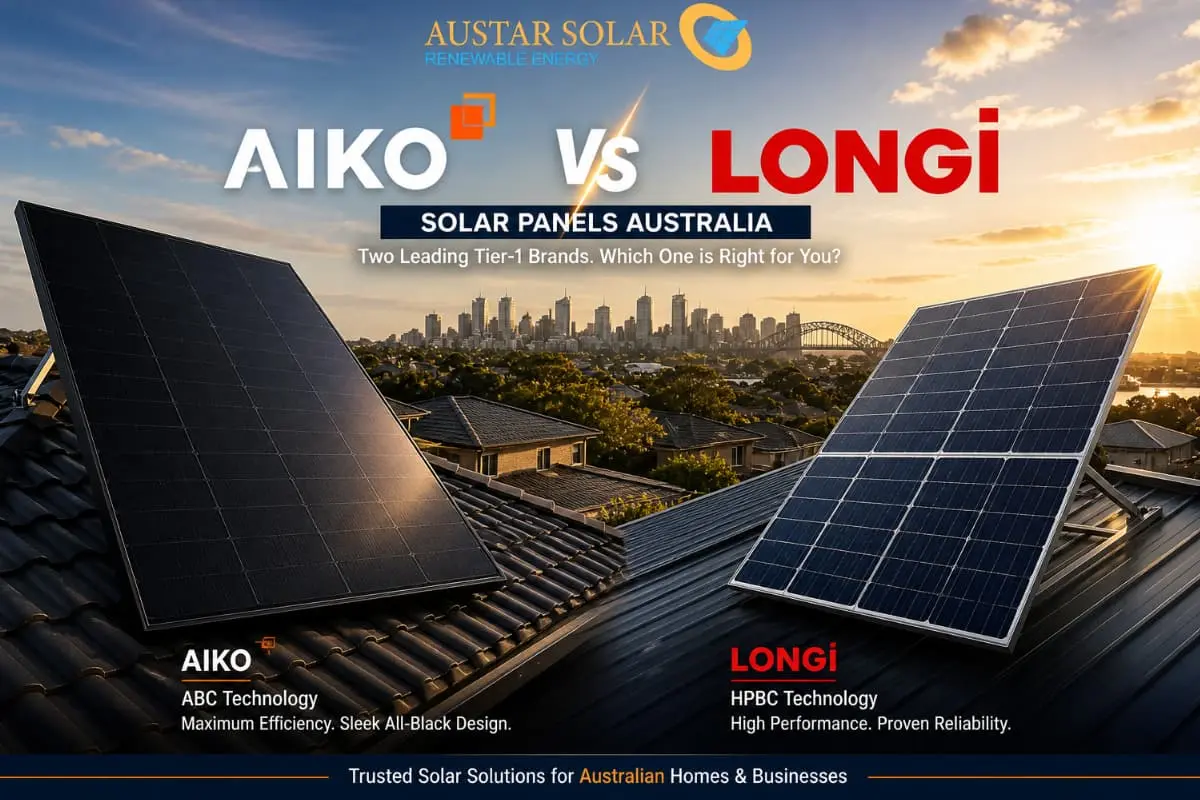
The decision between AIKO vs LONGi solar panels in Australia would be based on three major factors, which include efficiency, heat performance, and long-term reliability under extreme weather conditions in Australia. Each of the two brands is Tier-1, CEC-approved, and widely used in Australian households and businesses, but each is designed to meet different priorities.
The AIKO solar panels are based on the advanced ABC (All Back Contact) technology to deliver high efficiency and power per square meter, making them the best choice for small or limited roof areas. LONGi solar panels are based on HPBC technology and are oriented toward stable operation, low prices, and high availability within Australia.
This guide will compare AIKO solar vs LONGi solar Australia based on actual performance, lifespan, and cost to give homeowners an opportunity to choose the right system without getting confused and feeling influenced by marketing.
Brand Overview – AIKO vs LONGi Solar Panels
The first step in deciding between AIKO and LONGi is to determine the focus of their technologies, their market relevance, and their dependability in Australia. AIKO is a more recent and innovation-focused brand that is pushing efficiency limits, and LONGi is a long-established global leader that is known for scaling and proven performance.
AIKO Solar Panels Overview
AIKO is a technology-oriented solar manufacturer, established in 2009, specialising in high-efficiency N-type solar cells and modules. It has already become popular in Australia, having entered the market in about 2024 with high-tech ABC technology.
Its main strength is All Back Contact (ABC) technology that eliminates front grid lines to maximise the amount of sunlight that is absorbed and improve the output. This design allows module efficiencies of greater than 25% and makes AIKO one of the highest-performing panel brands available today.
AIKO also has an investment in R&D, with 1000+ patents and multiple research centres around the world, which positions it as a premium, innovation-driven brand.
In Australia, AIKO panels have been engineered to meet high heat, limited roof space, and high-end residential systems.
AIKO Pros:
- Higher efficiency and more power per panel
- Better heat and shading performance
- Premium modern technology
AIKO Cons:
- Higher cost
- Limited availability in some areas
LONGi Solar Panels Overview
LONGi is one of the largest and most established manufacturers of solar in the world, particularly in monocrystalline technology.
The company controls supply chains across the world and is reputed to manufacture dependable and cost-effective large quantities of solar panels. LONGi concentrates on PERC and new HPBC technologies, providing excellent performance with long-term stability.
Longi is popular in Australia due to its reputable track record, good installer network, and uniform performance on both residential and commercial projects.
In comparison with the premium positioning of AIKO, LONGi is a cost-effective option that is relatively affordable, durable, and reliable for most households.
LONGi Pros:
- Lower price and better value
- Strong installer network in Australia
- Proven long-term reliability
LONGi Cons:
- Slightly lower efficiency
- Lower premium output per square meter
Technology Comparison – ABC vs HPBC
In modern solar panels, the back-contact (BC) type of technology is used, where all the electrical wiring has been relocated to the back of the cell. This removes front-side shading, allowing more sunlight to reach the cell and increasing output by ~7% compared to traditional panels.
Both AIKO (ABC) and LONGi (HPBC) employ this design, yet, in terms of efficiency, cost, and practical use, they differ.
| Specification | AIKO Neostar (ABC – Australia Models) | LONGi Hi-MO 6 (HPBC – Australia Models) |
| Cell Technology | N-type ABC (All Back Contact) | HPBC / PERC / Hybrid Back Contact |
| Panel Type | Monocrystalline (N-type) | Monocrystalline (N-type / P-type) |
| Power Output (W) | 470W – 485W typical | 430W – 580W range |
| Max Efficiency | Up to 24.3% – 24.5% | ~22.3% (Hi-MO 6 typical) |
| Cell Efficiency | Higher due to the full rear contact design | Up to 25.3% cell efficiency (HPBC Pro) |
| Temperature Coefficient (Pmax) | ~ -0.26%/°C (better heat handling) | -0.29% to -0.34%/°C |
| First Year Degradation | ~1% | ~1% – 1.5% |
| Annual Degradation | ~0.35% or lower | ~0.35% – 0.50% |
| Performance Warranty | 30 years | 25–30 years |
| Product Warranty | 25 years | 12–25 years (model dependent) |
| Output After 25 Years | ~89%+ | ~87.7% |
| Output After 30 Years | ~88–89% | ~84–87% |
| Dimensions (Typical) | ~1762 x 1134 x 30mm | ~2278 × 1134 × 30 mm |
| Weight | ~20–22 kg | ~27–28.5 kg |
| Cell Count | ~108–120 cells | 144 cells |
| Voltage (Voc) | ~50–52V | ~51.5V |
| Current (Isc) | ~13–14A | ~14.4A |
| Max System Voltage | 1500V | 1500V |
| Operating Temp Range | -40°C to +85°C | -40°C to +85°C |
| Mechanical Load | High (hail + wind resistant) | 5400 Pa front / 2400 Pa rear |
| Shading Performance | Excellent (no front busbars) | Very good (anti-shading design) |
| Low-Light Performance | Superior (ABC design advantage) | Strong (HPBC/PERC optimization) |
| Aesthetic Design | Full black, no visible grid | Grid / black frame options |
Solar Panel Efficiency Comparison – Which Produces More Power?
Solar panel efficiency shows how much sunlight is converted into electricity. In Australia, higher efficiency directly means more energy from limited roof space, which improves long-term savings. AIKO and LONGi both use advanced back-contact designs, but their output levels differ slightly in real conditions.
AIKO Efficiency
AIKO solar panels use N-type ABC (All Back Contact) technology, which removes front grid lines and increases sunlight absorption. This results in about 23%–25% module efficiency, among the highest in residential solar.
In practical use:
- Produces more wattage per panel (around 470W–540W+)
- Delivers higher energy per square meter, useful for small roofs
- Performs better in heat and partial shading, improving daily output in Australian summers
Overall, AIKO generates more electricity from the same roof area, making it ideal when space is limited.
LONGi Efficiency
LONGi panels with HPBC technology typically deliver around 22%–23.5% efficiency, with advanced models reaching higher levels.
In practical use:
- Produces slightly lower power per panel than AIKO
- Still delivers stable and reliable daily output
- Performs well in low-light and variable weather conditions
- More flexible for larger systems due to cost advantage
Performance in Australian Conditions
The solar conditions in Australia are harsh, with high heat, strong UV radiation, exposure to salt in the coastal areas, dust, and frequent partial shading caused by trees or roof structures. Based on this, the real-world performance will be based on how well solar panels manage heat loss, durability, and shading effects over time. Both AIKO and LONGi do well in Australia, yet their strong suits manifest in different ways in day-to-day operations.
Heat Performance
AIKO is an N-type ABC technology with a low temperature coefficient of approximately -0.26% / C, which implies that less power is lost during extreme heat conditions and higher midday power output during Australian summers. LONGi HPBC panels typically range around -0.28% to -0.31%/o C which leads to slightly more efficiency loss at peak temperatures.
Key points:
- AIKO has a more consistent output in Queensland, WA, and NT heat zones.
- LONGi works well with a slight reduction in efficiency in extreme rooftop heat.
They both continue to perform effectively in normal Australian conditions.
Durability & Weather Resistance
The two brands are designed to withstand the challenging environment of Australia, such as UV exposure, hail impact, wind load, and corrosion in coastal regions. LONGi has a more extensive field experience with large-scale installations, whereas AIKO is concerned with the advanced design of the structure.
Key points:
- LONGi = established long-term reliability with millions of installations.
- AIKO = increased emphasis on anti-microcrack glass and cell protection.
They both apply to coastal and inland areas of Australia.
Shade Performance
AIKO works better in partial shading since its back-contact design eliminates electrical blockage and energy mismatch losses. LONGi HPBC panels also shade quite well, albeit with somewhat less efficiency in mixed shadow settings.
Key points:
- AIKO = trees, chimneys, and rooftops that are not even.
- LONGi = consistent, though with a little bit more shading losses.
Both have good low-light performance.
Price & Warranty Comparison in Australia (2026)
The decision on the type of solar panels in Australia is highly dependent on the initial outlay, warranty period, and long-term performance assurance. AIKO is a newer technology, premium, high-efficiency brand with an established market position and extensive installer support. LONGi is an older technology, value-based high-efficiency brand with a strong market presence and wide installer network.
They are both CEC-approved and are in common use in residential systems, but their prices and warranty structure vary in realistic installation quotes around Australia.
| Feature | AIKO (Neostar Series) | LONGi (Hi-MO X6 Series) |
| Retail Price (Per Panel) | ~$195 – $240 | ~$150 – $180 |
| Estimated $/W (Retail) | ~$0.31 / Watt | ~$0.25 – $0.29 / Watt |
| Product Warranty | 25 Years standard | 15 – 25 Years (Model dependent) |
| Performance Warranty | 30 Years (88.85% at Yr 30) | 25 – 30 Years (86.9% – 88.9% at end) |
| Max Module Efficiency | Up to 25% | Up to 23.2% |
| Aesthetics | All-black; no silver grid lines | Sleek “Explorer” and “Scientist” options |
| Best For | Limited roof space & premium design | Balance of performance and value |
Note*: All these prices can vary in different circumstances and states, so before any purchase, please make sure of the current prices of that product.
Availability & Installer Support in Australia
In Australia, solar panel choice is not only about efficiency but also about how easily panels are sourced, how stable the supply chain is, and how strong installer and warranty support is after installation. AIKO is a newer premium brand with fast-growing demand, while LONGi is a long-established global manufacturer with a large Australian distribution network and installer base. This creates a clear difference in availability and service support.
AIKO Availability & Installer Support
AIKO has entered Australia recently and is still expanding its distribution network. It is gaining popularity among premium installers due to its high efficiency and space-saving design, but supply is still developing in some regions.
- Availability is growing but is not yet fully widespread nationwide
- Stock depends heavily on approved distributors and installer allocation
- Strong technical support through Australian presence, but still building installer network depth
- Some installers may face delays or limited panel access during high-demand periods
- Warranty support is available locally, but is often handled through selected installation partners
In practice, AIKO is best for premium systems where installers already stock or source the panels directly.
LONGi Availability & Installer Support
LONGi has a long-established presence in Australia and is one of the most commonly installed solar brands nationwide. Its strong supply chain and large-scale manufacturing make it highly accessible.
- Widely available across all Australian states and regions
- Supported by a large network of installers and distributors
- Faster sourcing and replacement due to established inventory channels
- Easier warranty processing because of a mature local support structure
- Preferred by many installers for consistent supply and proven reliability
In practical terms, LONGi is easier to source and install quickly across both residential and commercial systems.
AIKO vs LONGi – Which One Should You Choose?
Choosing between AIKO and LONGi depends on whether you prioritize peak efficiency or proven market reliability. AIKO currently leads the market in performance with its All Back Contact (ABC) technology, reaching 24%+ efficiency, while LONGi’s Hi-MO X6 offers a balanced, high-output solution from the world’s largest manufacturer.
Choose AIKO if:
Choose AIKO if you have a small roof or want the most advanced tech currently available.
- Maximum Power Density: Because they hide all electrical contacts on the back, they fit more power into fewer panels.
- Superior Shading Response: AIKO panels handle partial shade better than almost any other brand, preventing the “bottleneck” effect.
- Premium Aesthetics: The pure black finish (no silver lines) is ideal for street-facing roofs.
Choose LONGi if :
Choose LONGi if you want a “safe bet” with a long-term track record.
- Unmatched Bankability: LONGi is a financial giant; you can be highly confident they will exist in 25 years to honor a warranty.
- Optimized Thermal Control: Their HPBC cells perform exceptionally well in the Australian heat, maintaining high output during summer.
- Value for Money: You get 95% of the performance of a premium panel at a significantly lower entry price.
Conclusion
In the AIKO vs LONGi solar panels Australia comparison, both brands are good options in the list of best solar panels Australia 2026, but they cater to different needs.
The AIKO solar panels in Australia are more efficient, perform better in heat, and have a stronger output per square meter, allowing them to be used in small areas of the roof and achieve maximum production.
LONGi solar panels are aimed at the following features: proven reliability, extended availability, and reduced cost of the system, which makes them a viable option for most Australian households.
According to real performance terms, AIKO is the leader in the high-efficiency index, and LONGi is the leader in the balanced value index. In the case of homeowners, the decision will be whether to have the maximum power or to have cost-effective stability in a long-term solar investment.