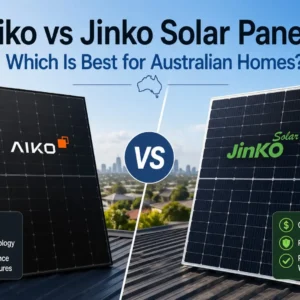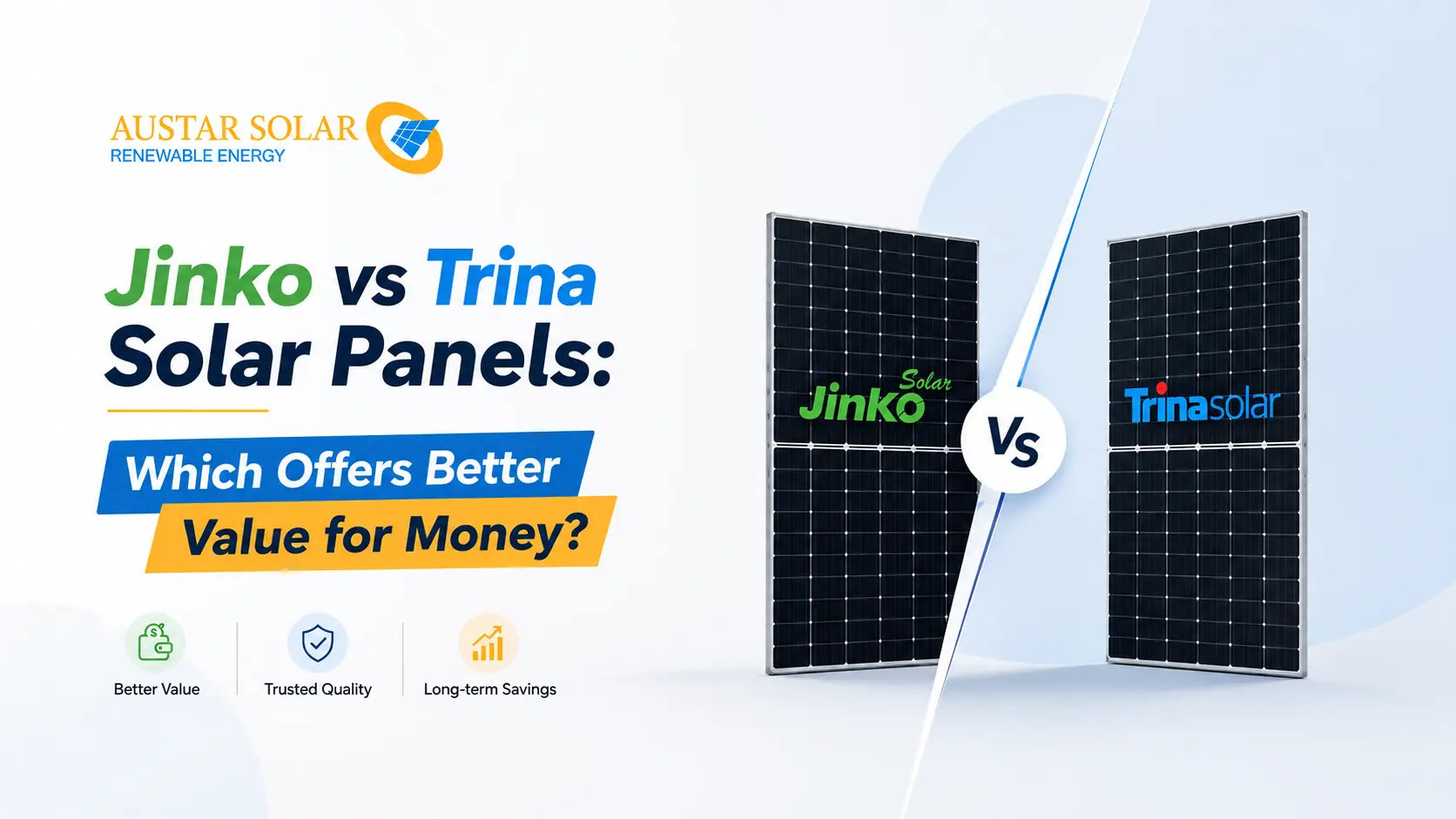
Jinko Solar and Trina Solar are two of the leading solar panel brands in Australia, and Jinko vs Trina Solar Panels are known for their high efficiency, durability, and long-term reliability. Jinko Solar is the better choice if you want the highest panel efficiency and maximum energy production from a smaller roof.
Trina Solar offers excellent performance at a more affordable price, making it a strong value-for-money option. Both brands provide premium N-type technology, up to 25-year product warranties, and 30-year performance warranties on selected models.
For Australian homeowners, Jinko is best for maximum efficiency, while Trina is the better choice for balancing performance, quality, and overall installation cost.
Overview of Jinko Solar Panels in Australia
Jinko Solar panels are, in fact, one of the most popular solar panels in Australia as they provide high efficiency, good durability, and value for money. These solar panels are suited for Australia’s hot climate as N-type TOPCon technology reduces power loss at high temperatures.
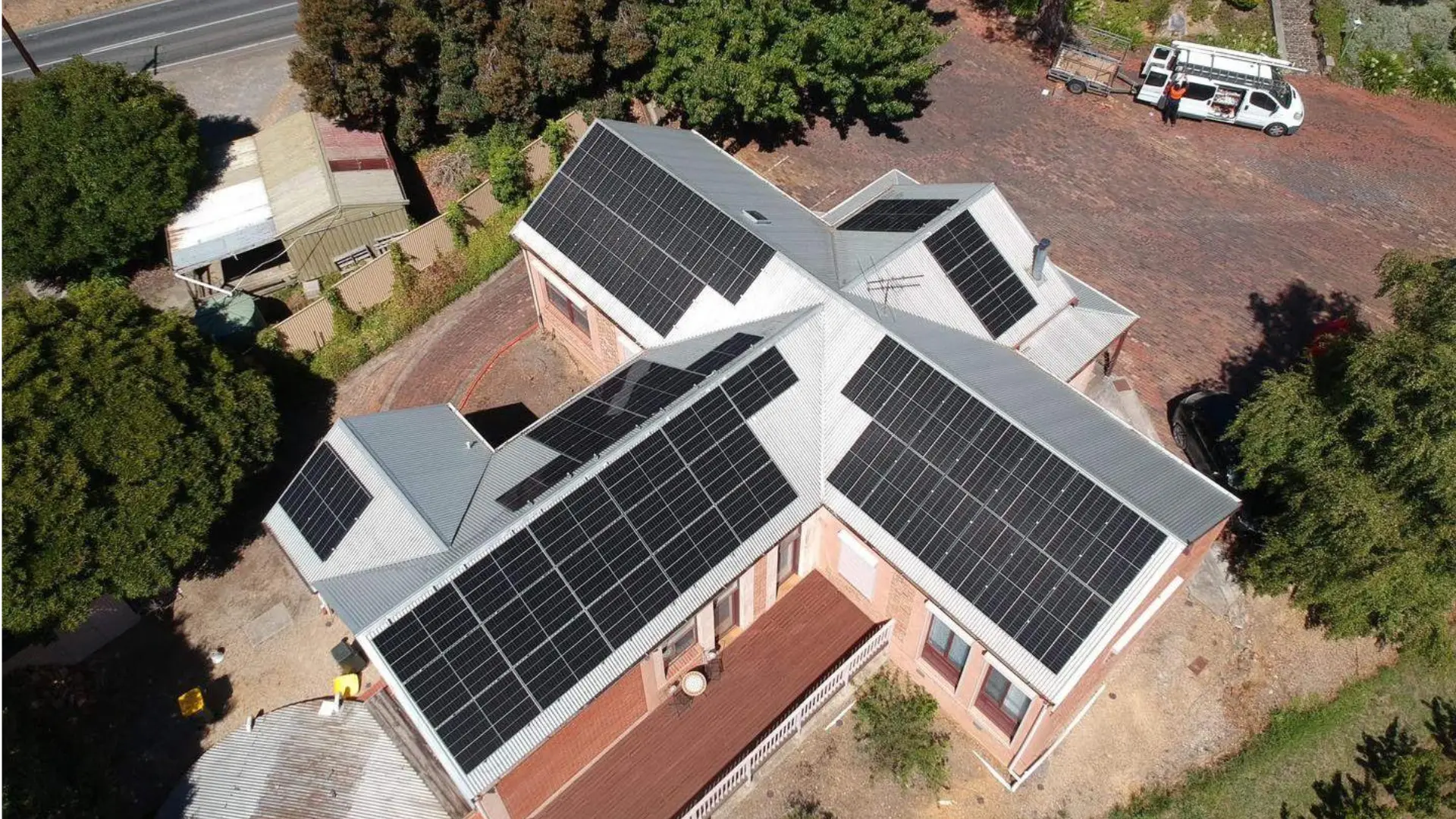
The bulk of newer models offer from 440W to 510W for residential use, with commercial panels offering even larger outputs. Jinko panels are designed to be resilient against wind, heavy rain, hail, and coastal conditions. They have a good track record, having been approved for use in Australia, and are installed by accredited solar installers nationwide.
With many models boasting a 25-year product warranty and performance warranties of up to 30 years, they’re a great long-term option for Australian homeowners and organisations wanting to reduce their electricity costs.
Key Features
- N-type TOPCon cell technology
- Power output: 440W–510W (residential models)
- Module efficiency: up to 24.8% (specific models)
- Excellent performance in Australia’s hot weather
- Low degradation for higher long-term energy production
- Strong resistance to hail, wind, and corrosion
- 25-year product warranty
- Up to a 30-year performance warranty
Pros
- High energy output and efficiency
- Performs well in Australia’s hot climate
- Long warranties for peace of mind
- Durable against harsh Australian weather
- Good value compared with many premium brands
Cons
- Premium N-type models cost more than entry-level panels
- Higher-wattage panels are larger and may not suit every roof
- Performance depends on professional installation and system design.
[Datasheet of Jinko Solar Panels]
Overview of Trina Solar Panels in Australia
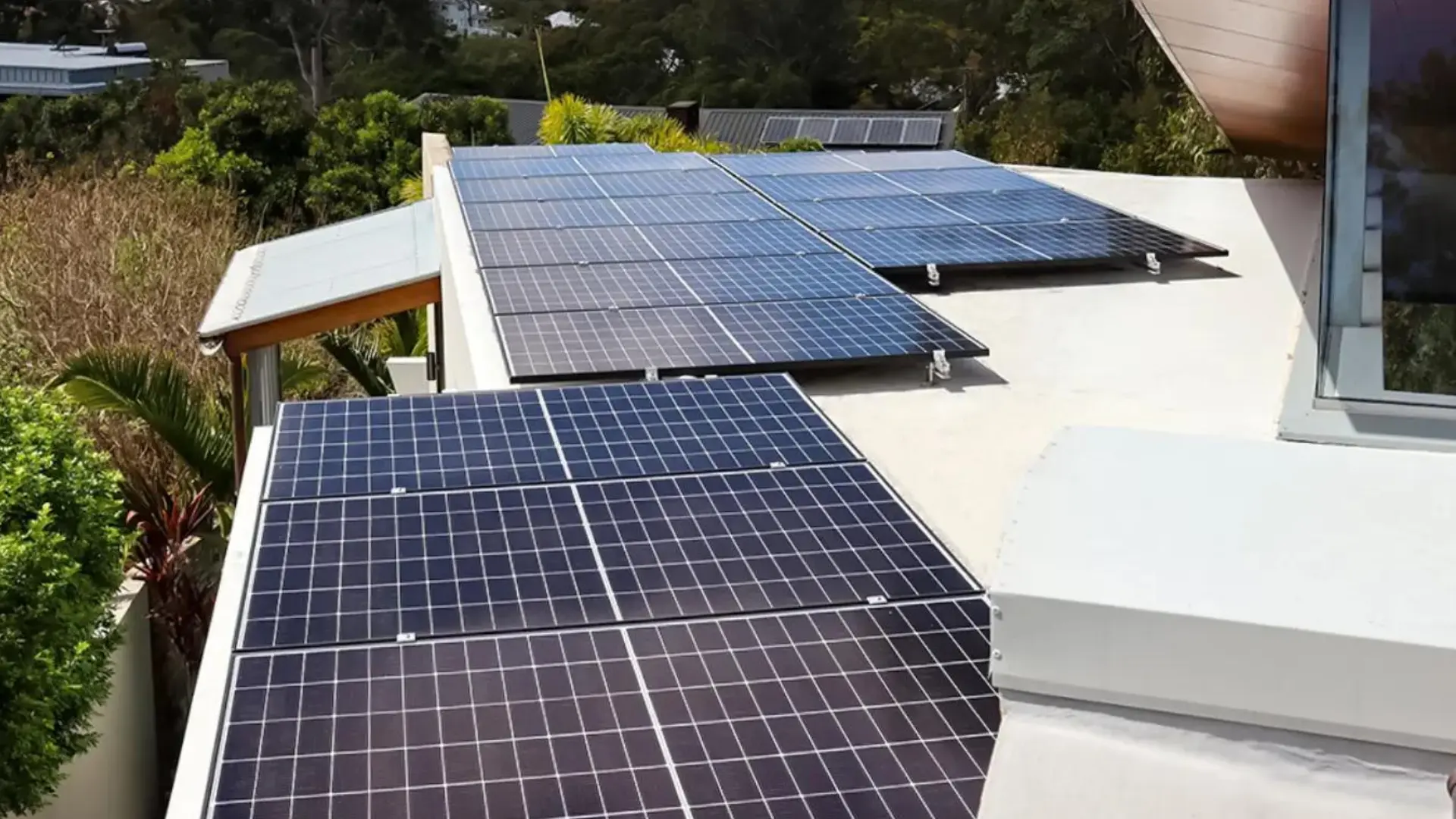
Trina Solar panels are among the most trusted solar panels in Australia. They are known for high efficiency, reliable performance, and good value for money. Trina Solar offers both residential and commercial solar panels that perform well in Australia’s hot climate.
Most panels use advanced N-Type i-TOPCon cell technology, which provides higher energy output, lower degradation, and better low-light performance. Trina panels are designed to withstand harsh weather, including strong winds, heavy snow, and high temperatures.
Many Australian installers recommend Trina because the brand has a long history of quality manufacturing and strong warranty support. Their panels are approved by the Clean Energy Council (CEC), making them eligible for Australian solar rebates when installed by an accredited installer.
With power ratings up to 720W for commercial models and around 440W–460W for residential systems, Trina Solar panels are an excellent choice for homeowners looking for efficient, durable, and affordable solar energy solutions.
Key Features
- Advanced N-Type i-TOPCon solar cell technology
- High efficiency of up to 23.3% (specific models)
- Excellent low-light performance
- Low annual power degradation
- Strong resistance to heat and harsh weather
- CEC-approved for Australian installations
- Suitable for homes, businesses, and large solar farms
Pros
- High energy efficiency
- Excellent performance in hot Australian conditions
- Long product and performance warranties
- Competitive pricing
- Trusted global manufacturer
Cons
- Premium models cost more than entry-level panels
- Warranty claims may require installer assistance
- Availability varies by Australian region
[Datasheet of Trina Solar Panels]
Jinko vs Trina Solar Panels: Technical Comparison in Australia
Jinko & Trina Solar are two of the highest-selling solar panel brands in Australia. They are both CEC-certified, use N-Type TOPCon technology, and have extremely hot-climate performance ideal for Australia. Initially, Jinko provides better efficiency and lower temperature loss, while Trina is more resistant, cheaper, and offers excellent long-term performance. Jinko has a slight upper hand in maximum efficiency, but in reality, either brand is a safe bet for most Australian homes.
Jinko vs Trina Solar Panels: Quick Comparison Table
| Feature | Jinko Solar | Trina Solar |
| Country of Origin | China | China |
| Latest Technology | N-Type TOPCon (Tiger Neo) | N-Type i-TOPCon (Vertex S+) |
| Residential Power Output | 440W–495W | 440W–460W |
| Commercial Power Output | Up to 670W+ | Up to 720W |
| Maximum Efficiency | Up to 24.8% (specific models) | Up to 23.3% (specific models) |
| Cell Type | Monocrystalline N-Type TOPCon | Monocrystalline N-Type i-TOPCon |
| Temperature Coefficient | Around -0.29%/°C | Around -0.29%/°C |
| First-Year Degradation | 1% | 1% |
| Annual Degradation | 0.40% | 0.40% |
| Performance Warranty | 30 Years | 30 Years |
| Product Warranty | Up to 25 Years | Up to 25 Years |
| Low-Light Performance | Excellent | Excellent |
| Heat Performance | Excellent for Australian summers | Excellent for Australian summers |
| Wind Load Rating | Up to 2,400 Pa | Up to 2,400 Pa |
| Snow Load Rating | Up to 5,400 Pa | Up to 5,400 Pa |
| CEC Approved | Yes | Yes |
| Best For | Maximum efficiency and premium performance | Value, reliability, and long-term performance |
| Typical Price in Australia | Slightly higher | Slightly lower |
Still deciding between Jinko and Trina Solar? Watch our detailed video comparison to see how these two leading solar brands compare on efficiency, performance, price, and long-term value in Australia.
Solar Panel Performance Comparison in Australia: Jinko vs Trina Solar Panels
Jinko and Trina Solar are among the best-performing solar panel brands in Australia. Both use advanced N-Type TOPCon technology, perform well in high temperatures, and are approved for Australian residential installations. Jinko offers slightly higher efficiency and power output, while Trina provides excellent long-term reliability and better value for money. For most Australian homes, the performance difference is small, and both brands deliver strong energy production over their lifespan.
Energy Output and Efficiency
The limited efficiency architecture of Jinko Solar panels brings efficiency up to 24.8%, while only 23.3% for Trina Solar panels. This means Jinko can harvest a little more energy from the same rooftop footprint, which makes it more suitable for homes with a tiny available rooftop surface.
Performance in the Australian Climate
The solar panel output in Australia’s high temperatures. Jinko and Trina have a temperature coefficient of about -0.29%/°C, which is great for maintaining performance on hot summer days. Likewise, their N-Type TOPCon cells boost electricity output under cloudy conditions and in the early morning or late afternoon.
Long-Term Reliability
Both include 25-year product warranties and 30-year performance warranties. They experience a first-year degradation of just 1%, then only 0.40% degradation each year, so you have over 87% of their original output after 30 years.
Customer Feedback and Real-Life Example
Australian homeowners consistently give positive feedback for both brands. Jinko users often mention higher daily energy production and lower electricity bills, especially in homes with smaller roofs. Trina owners frequently praise the panels for reliable performance, durability, and excellent value over many years.
For example, a family in Brisbane installed a 6.6 kW Jinko Solar system and regularly generates 26–30 kWh on clear summer days, significantly reducing grid electricity use. A similar household in Adelaide using a 6.6 kW Trina Solar system typically produces 25–29 kWh under the same weather conditions. While Jinko delivers slightly higher output, the difference in annual energy generation is small, making both brands excellent choices for Australian homeowners.
Jinko and Trina Solar Panels Price & Warranty Comparison in Australia (2026)
In the Australian solar market, Jinko Solar and Trina Solar are both top-tier, highly trusted options that offer excellent reliability. Generally, Jinko Solar leans slightly toward higher efficiency and longer premium performance warranties (up to 30 years), while Trina Solar often provides an ultra-durable dual-glass design with highly competitive upfront pricing.
Jinko and Trina Solar Panels Price in NSW 2026
| Brand | Series | Model | Power (W) | Approx. NSW Price Range (AUD/panel) |
| Jinko | Tiger Neo | 415W | 415 | $145–170 |
| Jinko | Tiger Neo | 430W | 430 | $150–175 |
| Jinko | Tiger Neo | 440W | 440 | $155–180 |
| Jinko | Tiger Neo | 475W | 475 | $170–195 |
| Jinko | Tiger Neo | 495W | 495 | $180–205 |
| Jinko | Tiger Neo | 510W | 510 | $190–215 |
| Jinko | Tiger Neo Utility | 600–670W | 600–670 | $220–320 |
| Jinko | Eagle | 330–350W | 330–350 | $120–155 |
| Jinko | Cheetah HC | 325–345W | 325–345 | $145–170 |
| Trina | Vertex S+ | 495W | 495 | $165–190 |
| Trina | Vertex S+ | 500W | 500 | $170–195 |
| Trina | Vertex S+ | 505W | 505 | $175–200 |
| Trina | Vertex S+ | 510W | 510 | $180–205 |
| Trina | Vertex S+ | 515W | 515 | $185–210 |
| Trina | Vertex S+ | 525W | 525 | $190–220 |
| Trina | Vertex N | 610–650W | 610–650 | $230–310 |
| Trina | Vertex Utility | 690–740W | 690–740 | $280–380 |
A Standard Comparision between Jinko Tiger Neo Series and Trina Vertex S+ Series
| Feature / Metric | Jinko Solar Panels (e.g., Tiger Neo Series) | Trina Solar Panels (e.g., Vertex S+ Series) |
| Estimated Upfront Cost | Slightly higher upfront cost for premium N-Type tech. | Highly cost-effective; excellent value for tight budgets. |
| 6.6 kW System Price | ~$4,490 to $6,490 AUD (Fully installed, post-STC rebate). | ~$4,200 to $6,100 AUD (Fully installed, post-STC rebate). |
| Product Warranty | Up to 25 years on premium lines (12-15 years on entry-level). | Up to 25 to 30 years (30 years specifically for dual-glass models). |
| Performance Warranty | 25 to 30 years (Guarantees ~87.4% output at year 25/30). | 25 to 30 years (Guarantees power output retention over time). |
| Max Panel Efficiency | Up to 22.53% (Excellent for small or constrained roof spaces). | Up to 21.4% to 22% (Very strong, reliable energy yield). |
| Heat Tolerance | Superb; N-type silicon degrades less in intense Aussie summers. | Very good; proven high heat tolerance across Australia. |
| Australian Support | Strong local presence via Jinko Solar Australia subsidiary. | Long-standing local office with highly dependable claims support. |
Which Solar Panel Brand Is More Efficient in Australia?
Jinko Solar is slightly more efficient than Trina Solar in Australia if you compare their latest premium residential panels. Jinko’s top models, such as the Tiger Neo series, reach up to 24.8% efficiency, while Trina’s Vertex S+ panels typically achieve around 22.5%–23.0% efficiency. This means Jinko panels can produce more electricity from the same roof area, making them a better choice for homes with limited roof space.
Efficiency Comparison
- Jinko Solar: Up to 24.8% panel efficiency (specific models).
- Trina Solar: Around 22.5%–23.0% panel efficiency (specific models).
- Winner: Jinko Solar for maximum energy output per square metre.
Which Brand Should You Choose?
Choose Jinko Solar if your goal is the highest efficiency and maximum power generation from a smaller roof. Choose Trina Solar if you want excellent performance, proven reliability, and strong value at a slightly lower price. For most Australian homes with enough roof space, the real difference in yearly electricity production is small, but Jinko offers a slight advantage in overall efficiency.
Conclusion
Both Jinko Solar and Trina Solar offer great bang for your buck for Australian homeowners and perform well in Australian conditions. However, with its higher panel efficiency, Jinko Solar is recommended for homes with limited roof space or homeowners seeking to produce the most energy possible.
Trina Solar delivers tremendous value because it offers strong performance and bankable reliability at a lower cost. Both brands offer lengthy warranties on products and performance, providing long-term peace of mind. The option you should pick solely depends on your expenses, the roof size, and your energy needs. Choose Jinko if efficiency is your priority. If pure value for money is your main criterion, go for Trina.
FAQs on Jinko vs Trina Solar Panels
Are Jinko Solar panels good for hot Australian weather?
Yes. Jinko Solar panels perform well in high temperatures and harsh Australian weather, helping maintain strong energy production throughout the year.
Are Trina Solar panels suitable for Australian homes?
Yes. Trina Solar panels are designed for Australian conditions and provide reliable performance in hot summers, coastal areas, and varying weather conditions.
Which brand produces more electricity?
Jinko usually produces slightly more electricity because its premium panels have higher efficiency. However, the yearly difference is small for most Australian households.
Which brand is better for small roofs?
Jinko Solar is the better choice for small roofs because its higher efficiency allows more electricity generation from limited roof space.
Do Jinko and Trina panels work on cloudy days?
Yes. Both brands continue producing electricity on cloudy days, although output is lower than during full sunlight, which is normal for all solar panels.