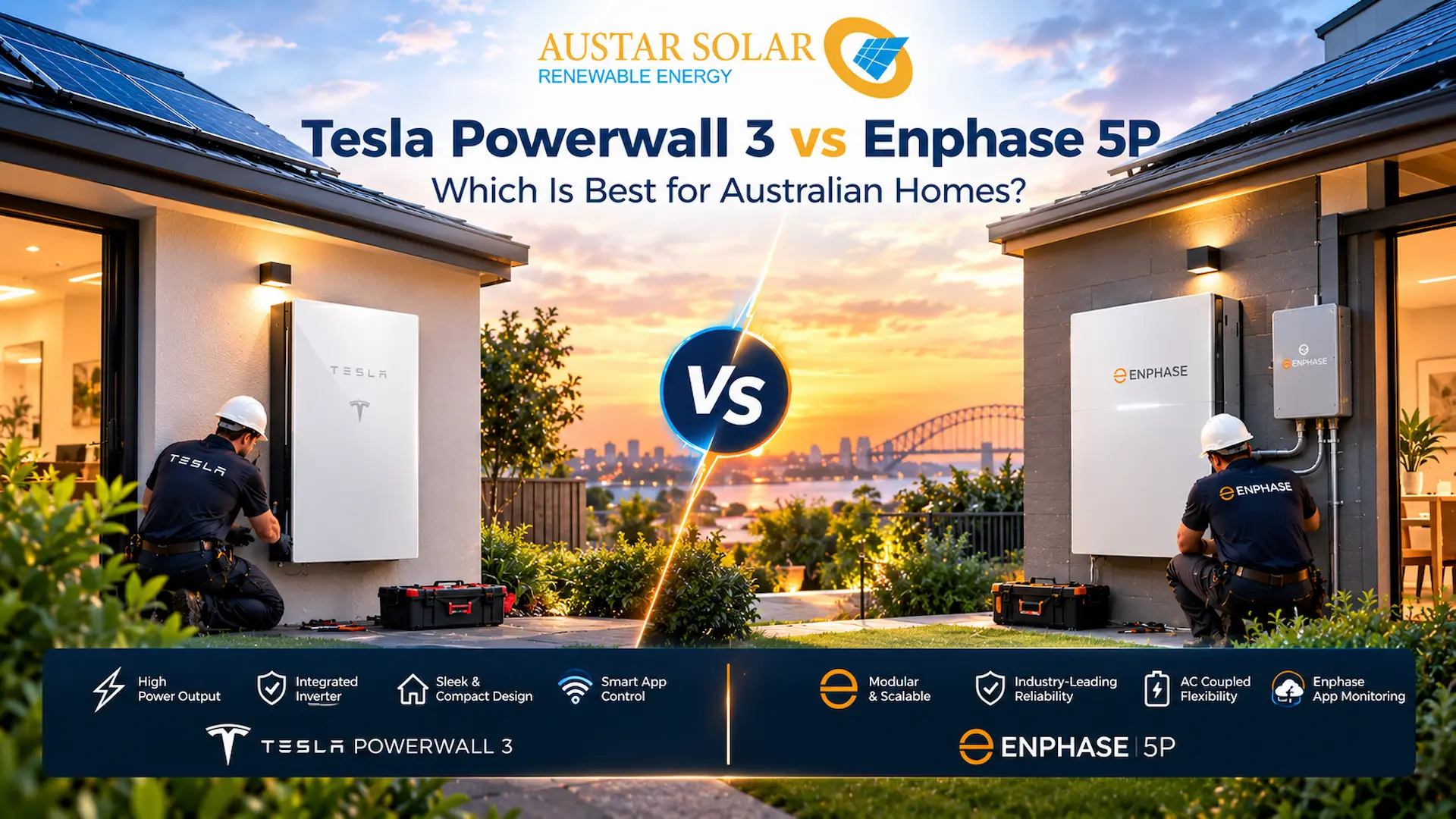
The Enphase 5P vs Tesla Powerwall 3 comparison helps Australian homeowners choose the right home battery for their solar system. Tesla Powerwall 3 offers 13.5 kWh of storage in one unit, while Enphase 5P provides 5 kWh per unit.
Tesla suits households that need more stored energy and greater power from a single battery. Enphase suits homeowners who prefer smaller storage units and the flexibility to expand their system.
Both batteries help households use more solar energy at night, reduce electricity bills, and keep essential appliances running during power outages with compatible equipment.
Price, storage needs, backup support and installation costs are important factors to consider before choosing between these two home batteries.
Overview of Enphase 5P battery storage in Australia
The Enphase IQ Battery 5P is a home battery storage system designed to store excess solar energy for later use. In Australia, it helps households use more of their solar power, reduce reliance on grid electricity, and maintain power during outages when installed with compatible backup equipment. The battery offers 5 kWh of usable storage capacity and uses lithium iron phosphate (LFP) chemistry.

Key Features
The Enphase IQ Battery 5P includes six built-in microinverters. Its all-in-one, AC-coupled design supports installation with compatible solar systems. The battery delivers up to 3.84 kVA of continuous output power in single-phase configurations.
- Usable capacity: 5 kWh per battery unit.
- Battery chemistry: Lithium iron phosphate (LFP).
- Power output: Up to 3.84 kVA continuous in single-phase configurations.
- Backup support: Provides backup power with compatible Enphase equipment.
- Expandable storage: Multiple units can increase total storage capacity.
- Warranty: 15 years or up to 6,000 cycles, subject to warranty terms.
- Monitoring: The Enphase App lets users monitor and manage their energy system.
Is the Enphase 5P Battery Suitable for Australian Homes?
The Enphase IQ Battery 5P suits households that need modular solar storage and want to increase their solar energy use. Its FlexPhase version supports both single-phase and three-phase installations. However, one 5 kWh unit may not provide enough storage for homes with high evening energy demand. Households should assess their electricity usage, backup requirements, and installation costs before choosing a system.
To know more details, you can read our Enphase Home Battery Review Australia: Pros, Cons, and Who Should Buy
Overview of Tesla Powerwall 3 Battery Storage in Australia
The Tesla Powerwall 3 is a home battery storage system that stores excess solar energy for use at night, during peak electricity periods, or during power outages. It combines a battery and an integrated solar inverter in one unit. Australian households can use it to increase solar self-consumption, reduce grid electricity use, and improve energy independence.

Key Features
The Tesla Powerwall 3 offers 13.5 kWh of usable battery capacity. It uses lithium iron phosphate (LFP) battery chemistry and delivers up to 11.04 kW of continuous power in supported Australian configurations. Its integrated solar inverter can simplify installation for homes adding a new solar system.
- Usable capacity: 13.5 kWh for everyday household energy storage.
- Continuous power: Up to 11.04 kW, depending on the configuration.
- Integrated inverter: Connects directly with compatible solar panels.
- Backup power: Supports essential household circuits during outages with suitable backup equipment.
- Expandable storage: Compatible expansion options can increase total storage capacity.
- Energy monitoring: The Tesla app tracks solar generation, battery charging, and household electricity use.
- Weather protection: Designed for indoor or outdoor installation.
Is Tesla Powerwall 3 Suitable for Australian Homes?
The Tesla Powerwall 3 suits households with solar panels and high evening electricity demand. Its larger storage capacity can support more household appliances than a single 5 kWh battery. However, actual backup performance depends on electrical loads and installation design. Before purchasing, compare the installed price, warranty, energy usage, and available battery rebates.
To know more details, see Tesla Powerwall 3 Review 2026: Price, Performance & Is It Worth It in Australia?
Technical Comparison of Enphase 5P vs Tesla Powerwall 3
The Enphase IQ Battery 5P vs Tesla Powerwall 3 comparison comes down to storage capacity, power output, inverter design, and system flexibility. The Enphase 5P offers 5 kWh of usable storage per unit, while the Tesla Powerwall 3 provides 13.5 kWh in one unit. Both store solar energy for later use and can support home backup with compatible equipment. However, their technical designs suit different household energy needs.
| Technical Specification | Enphase IQ Battery 5P | Tesla Powerwall 3 |
| Usable Battery Capacity | 5 kWh per unit | 13.5 kWh per unit |
| Battery Chemistry | Lithium Iron Phosphate (LFP) | Lithium Iron Phosphate (LFP) |
| Continuous Power Output | 3.84 kVA in single-phase configuration | Up to 11.04 kW, depending on configuration |
| Inverter Design | Six integrated microinverters | Integrated solar inverter |
| System Type | AC-coupled | DC-coupled solar and battery system |
| Solar Compatibility | Compatible with existing solar systems and suitable Enphase equipment | Integrated inverter suits new solar installations; compatibility depends on the existing system |
| Phase Compatibility | Single-phase and three-phase with FlexPhase | Single-phase output; three-phase installations have configuration limits |
| Backup Capability | Yes, with compatible Enphase backup equipment | Yes, with compatible Tesla backup equipment |
| Expandable Storage | Add compatible 5P batteries | Add compatible Powerwall 3 Expansion units |
| Monitoring | Enphase App | Tesla App |
| Warranty | 15 years or up to 6,000 cycles, subject to terms | 10 years, subject to terms |
| Best Suited For | Modular storage and compatible existing solar systems | Higher storage capacity and greater continuous power from one unit |
Performance Comparison In Australia
Tesla Powerwall 3 and Enphase IQ Battery 5P both help Australian households store solar energy and reduce grid electricity use. However, Tesla offers more storage and higher power output from one unit. Enphase provides smaller, modular storage that suits different system sizes.
Real-Life Performance
Tesla Powerwall 3
- Its 13.5 kWh capacity can support evening electricity use, including multiple household appliances.
- Higher power output makes it suitable for homes with larger energy demands.
- Actual backup time depends on appliance use, battery charge, and solar generation.
Enphase IQ Battery 5P
- Its 5 kWh capacity suits smaller energy needs or gradual system expansion.
- Its AC-coupled design can simplify integration with compatible existing solar systems.
- Multiple units can increase storage capacity and available power.
Customer Feedback and Practical Considerations
Public reviews and installer reports vary, so these points describe common buying considerations rather than verified customer experiences.
- Tesla: Buyers may value its larger capacity and integrated inverter design.
- Enphase: Buyers may prefer its modular design and 15-year limited warranty.
- Both systems: Installation quality, app reliability, and local installer support can affect satisfaction.
Which Performs Better?
Tesla Powerwall 3 suits households needing greater storage and power from one battery. Enphase 5P suits homes prioritising modular expansion and compatibility with existing solar systems. Compare installed costs and backup requirements before choosing.
Price Comparison of Enphase 5P and Tesla Powerwall 3 in Australia
The Enphase IQ Battery 5P vs Tesla Powerwall 3 price comparison depends on storage capacity, installation requirements, and available battery rebates. Enphase 5P is priced per 5 kWh unit, while Tesla Powerwall 3 offers 13.5 kWh in one unit. The estimates below use Australian dollars (AUD) and distinguish equipment costs from installation costs. Actual quotes vary by location, existing solar equipment, and electrical work.
| Price Component | Enphase IQ Battery 5P | Tesla Powerwall 3 |
| Usable storage capacity | 5 kWh | 13.5 kWh |
| Approximate battery and equipment cost | 4,000–6,000 | 11,450–13,500 |
| Approximate installation cost | 1,500–2,500 | 2,000–3,500 |
| Approximate total installed cost | 5,500–8,500 | 14,400–17,800 |
| Approximate installed cost after federal rebate | 4,200–7,200 | 11,000–14,400 |
Which Battery Offers Better Value?
- Enphase IQ Battery 5P suits households that want smaller storage capacity and the option to add compatible units later.
- Tesla Powerwall 3 offers substantially more storage and higher power output from one unit, which may suit households with greater energy needs.
Important Note: Compare installed quotes on a like-for-like basis. Check backup equipment, switchboard upgrades, warranty coverage, and rebate eligibility before making a decision.
Which Is More Efficient in Australia, Enphase or Tesla?
The Enphase IQ Battery 5P vs Tesla Powerwall 3 efficiency comparison depends on energy conversion, storage capacity, and how each system works with solar panels. Both batteries help Australian households store surplus solar energy for later use. However, their system designs differ. Enphase 5P uses an AC-coupled design with integrated microinverters, while Tesla Powerwall 3 includes an integrated solar inverter. These differences affect how energy flows through each system.
Efficiency Comparison
Tesla Powerwall 3 has a published solar-to-grid inverter efficiency of 97.5%. Enphase IQ Battery 5P specifies 90% AC round-trip efficiency under stated test conditions. These figures measure different things, so they should not be treated as a direct comparison.
Which Battery Is More Efficient?
- Tesla Powerwall 3 suits households installing a new solar system and wanting an integrated inverter.
- Enphase IQ Battery 5P suits homes needing modular storage and compatibility with suitable existing solar systems.
- Real-world efficiency for both depends on temperature, charging levels, power demand, and standby consumption.
Overall, Tesla offers strong inverter efficiency, while Enphase provides a published 90% AC round-trip efficiency. Choose based on the complete system design rather than one efficiency figure.
Conclusion
Choosing between Enphase 5P and Tesla Powerwall 3 depends on your household’s energy needs, budget, and existing solar system. Tesla Powerwall 3 is a strong choice for homes that need more storage and greater power from one battery.
Enphase 5P suits households that prefer smaller storage units with the option to expand later. Both batteries can help reduce grid electricity use and make better use of solar energy. Before making a decision, compare the total installation cost, warranty, backup features, and available rebates in Australia.
Auster Solar can help homeowners compare suitable battery options based on their solar setup and daily electricity use. The right choice should balance cost, storage capacity, and long-term household needs.
FAQs on Enphase 5P vs Tesla Powerwall 3
Does Tesla Powerwall 3 Reduce Electricity Bills?
Tesla Powerwall 3 can reduce grid electricity use by storing excess daytime solar energy for evening consumption. Savings depend on electricity rates, battery usage, solar generation, and installation costs. It does not guarantee lower bills for every household.
Which Battery Is Better for Three-Phase Homes?
Both systems can support suitable three-phase installations, but their configurations differ. Enphase FlexPhase supports single-phase and three-phase applications. Tesla Powerwall 3 has specific phase and backup limitations, so installers should confirm compatibility for your property.
Can Tesla Powerwall 3 Charge From the Grid?
Tesla Powerwall 3 can support grid charging when the system configuration and settings allow it. Availability may depend on local requirements, electricity plans, and backup settings. Check the installation details and your electricity provider’s conditions.
Can Tesla Powerwall 3 Work With Existing Solar Panels?
Tesla Powerwall 3 may work with existing solar installations, depending on the inverter and system configuration. Its integrated solar inverter is particularly useful for suitable new installations. A qualified installer should confirm compatibility before installation.
Which Battery Is Better for Power Outages?
Both batteries can provide backup power with compatible equipment. Tesla offers greater storage capacity in one unit, while Enphase can provide backup through a suitable system configuration. Backup duration depends on connected appliances and available stored energy.