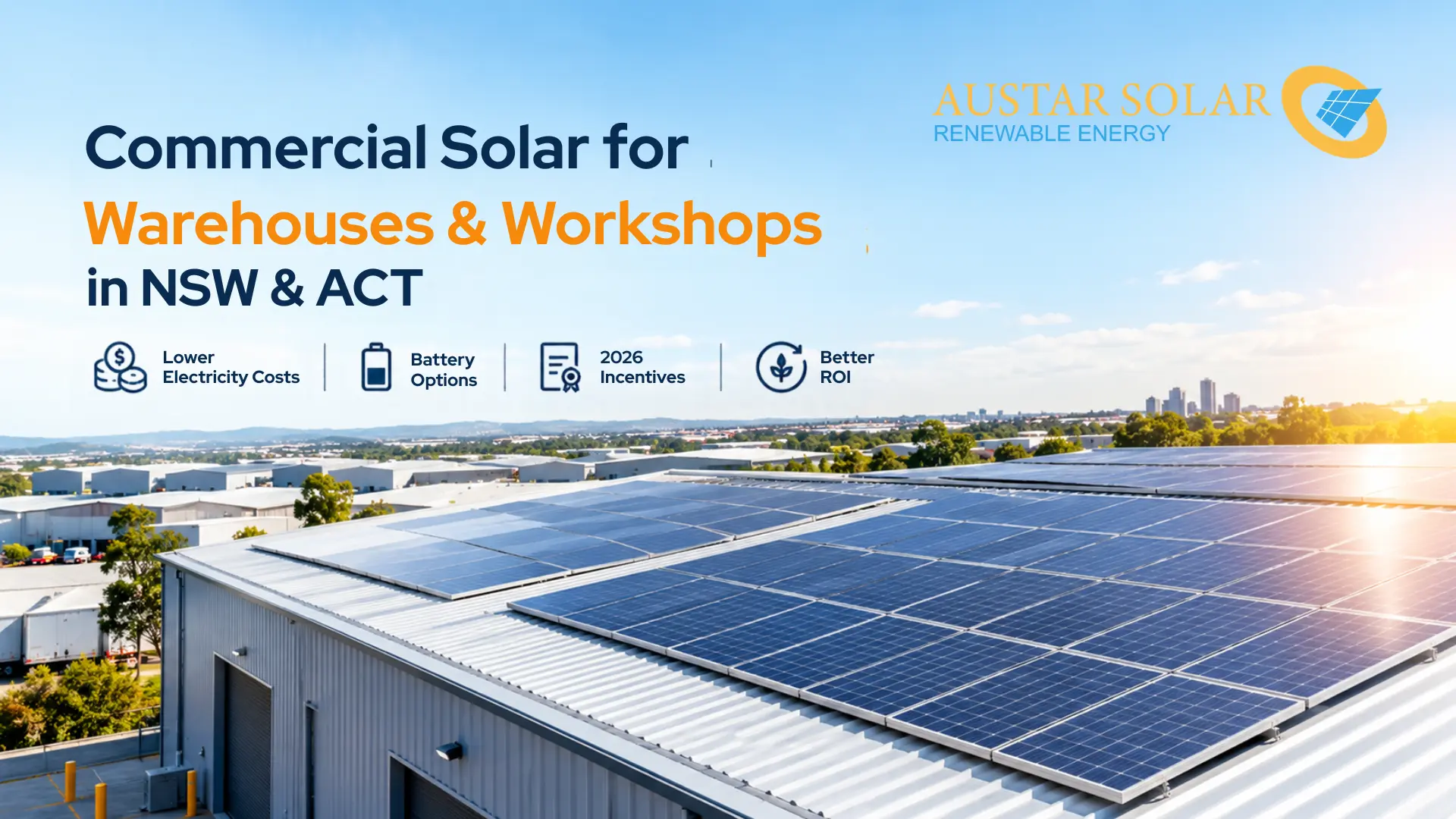
Commercial solar for warehouses in NSW and the ACT can help businesses reduce electricity costs by generating power directly on site. Warehouses, workshops, manufacturing facilities and distribution centres often have large roof areas and substantial electricity demand from lighting, machinery, refrigeration, ventilation, forklifts and electric vehicle (EV) charging.
However, the best solar system is not necessarily the largest one your roof can accommodate. The right design depends on when your business uses electricity, your energy tariff, roof condition, network connection requirements and future energy needs.
There are also important incentive changes in 2026. Eligible solar PV systems between 100 kW and 1 MW installed from 1 October 2026 can qualify under the expanded Small-scale Renewable Energy Scheme (SRES), subject to the applicable requirements. NSW businesses may also qualify for incentives when installing eligible commercial batteries.
This guide explains how to assess your warehouse roof, size a commercial solar system, compare installation costs, understand available incentives and estimate the potential return on investment.
Key Takeaways
- Commercial solar is particularly suitable for businesses with substantial daytime electricity consumption.
- System size should be based on electricity bills, interval data, operating hours and network limits rather than roof area alone.
- Eligible solar systems from 100 kW to 1 MW installed from 1 October 2026 can access the expanded SRES, subject to scheme requirements.
- Batteries can support evening loads, reduce some demand peaks and provide backup when specifically configured.
- Commercial solar prices and payback periods vary significantly between sites.
- A detailed site assessment and transparent financial model are essential before committing to an installation.
1. Which Businesses Benefit Most From Commercial Solar?
Commercial solar can suit many businesses, but its financial value depends on how much electricity a site consumes while its panels are generating power.
| Business type | Main opportunity | Important consideration |
| Warehouses | Offset daytime electricity consumption | Weekend use and overnight loads |
| Workshops | Supply machinery, tools and ventilation | Operating hours and equipment demand |
| Manufacturing facilities | Reduce grid purchases during production | Large motors and changing load profiles |
| Cold storage | Offset refrigeration demand | Continuous overnight consumption |
| Distribution centres | Supply lighting, conveyors and charging | Automation and EV charging requirements |
| 24-hour operations | Reduce part of a continuous electricity load | Battery economics and overnight demand |
Warehouses and workshops often use electricity for lighting, heating, cooling, extraction, compressors, conveyors, CNC machines, refrigeration, office equipment and forklift charging.
When these loads operate during daylight hours, solar generation can replace electricity that would otherwise be purchased from the grid.
A day-shift workshop may therefore use a high proportion of its solar electricity directly. A warehouse operating around the clock may have more overnight demand, so its system needs a more detailed assessment.
If forklift charging represents a significant part of your consumption, read our guide to warehouse solar and forklift charging.
2. Is Your Warehouse Roof Suitable for Solar?
A large roof does not automatically make a building suitable for solar. Roof condition, structural capacity, shading, mounting options, and safe access all affect installation feasibility and cost.
Roof type and condition
| Roof type | General suitability | What to check |
| Metal deck or standing seam | Often suitable | Compatible mounting clamps and roof condition |
| Corrugated or trapezoidal metal | Often suitable | Roof-specific brackets and weatherproofing |
| Concrete or flat membrane | Often suitable | Mounting design, wind loads and waterproofing |
| Suspected asbestos-containing roofing | Specialist assessment required | Safe identification and management before work |
| Older or unusual roof structures | Requires individual assessment | Structural capacity and existing defects |
Before installing panels, inspect the roof for rust, leaks, damaged sheeting, loose fixings, corrosion and areas where water pools.
Solar panels are intended to operate for many years. If the roof is likely to need replacement soon, repairing or replacing it before installation may avoid the cost of removing and reinstalling the solar system later.
Structural capacity and mounting
Panels and mounting equipment add weight to a roof. Older or lightweight structures may require assessment by a suitably qualified structural engineer.
The design should also account for wind loading, roof geometry, attachment points and site conditions. Ask whether engineering documentation and any required roof reinforcement are included in the quotation.
Shading, orientation and access
Check for shade from air-conditioning units, exhaust stacks, parapets, nearby buildings, trees and other rooftop equipment. The designer should assess how shading affects the proposed layout and electrical configuration.
North-facing panels can produce strong annual generation in NSW and the ACT. East-west layouts may also suit flat commercial roofs by spreading generation across the day and potentially matching morning or afternoon electricity demand more closely.
Safe access is equally important. Roof anchor points, edge protection, scaffolding, walkways and protection around skylights or fragile roof sections may be necessary.
For a more detailed assessment, see our guide to warehouse roof suitability for solar panels.
Warehouse roof suitability checklist
Before requesting a quote, establish whether:
- You know the roof material, age and general condition.
- Major roof repairs or replacement are unlikely to be needed soon.
- Potential asbestos-containing materials have been appropriately assessed.
- Usable roof area has been estimated after excluding skylights, plant and access paths.
- Shading and roof orientation have been considered.
- The site’s electrical supply and switchboard capacity are understood.
- Safe roof access can be provided.
- At least 12 months of electricity bills and, where available, interval data can be supplied.
- Landlord approval has been considered for leased premises.
- Future expansion, machinery, and EV charging plans are known.
3. How Much Solar Does Your Business Need?
The right commercial solar system size depends on your electricity consumption, operating hours, tariff, available roof area, electrical infrastructure, and network connection conditions.
Filling the roof with panels is not always the most economical approach. If a system generates more electricity than your business can use, the surplus may be exported at a lower value than the cost of electricity you avoid buying.
Start with electricity bills and interval data
Review at least 12 months of electricity bills to understand total consumption, seasonal changes and energy costs.
Where available, obtain interval data showing electricity use throughout the day. Depending on the meter, this may record consumption in 30-minute intervals or other time periods.
This allows the installer to compare your actual demand with the expected solar generation profile.
For example:
- A workshop operating from 7 am to 5 pm may use much of its solar generation directly.
- A cold-storage warehouse may require electricity overnight, making storage worth assessing.
- A business that closes on weekends may export more electricity during those days.
- A site planning to add EV chargers or machinery may need a design that accounts for future demand.
Estimate solar generation
Generation varies with location, orientation, tilt, shading, weather, equipment and system losses. Broad city-wide estimates can help with early planning, but they should not replace site-specific modelling.
Your installer should compare different system sizes and explain the expected annual generation, on-site consumption, exports and grid imports.
A good sizing process should include:
- Reviewing electricity bills and interval data.
- Inspecting the roof and assessing shading.
- Checking switchboard and supply capacity.
- Confirming network connection requirements and export limits.
- Modelling multiple system sizes.
- Assessing future loads and whether battery storage improves the economics.
The goal is to maximise useful solar generation and financial value, not simply the number of installed panels.
4. How Commercial Solar Reduces Electricity Costs
Commercial solar can lower electricity costs in three main ways.
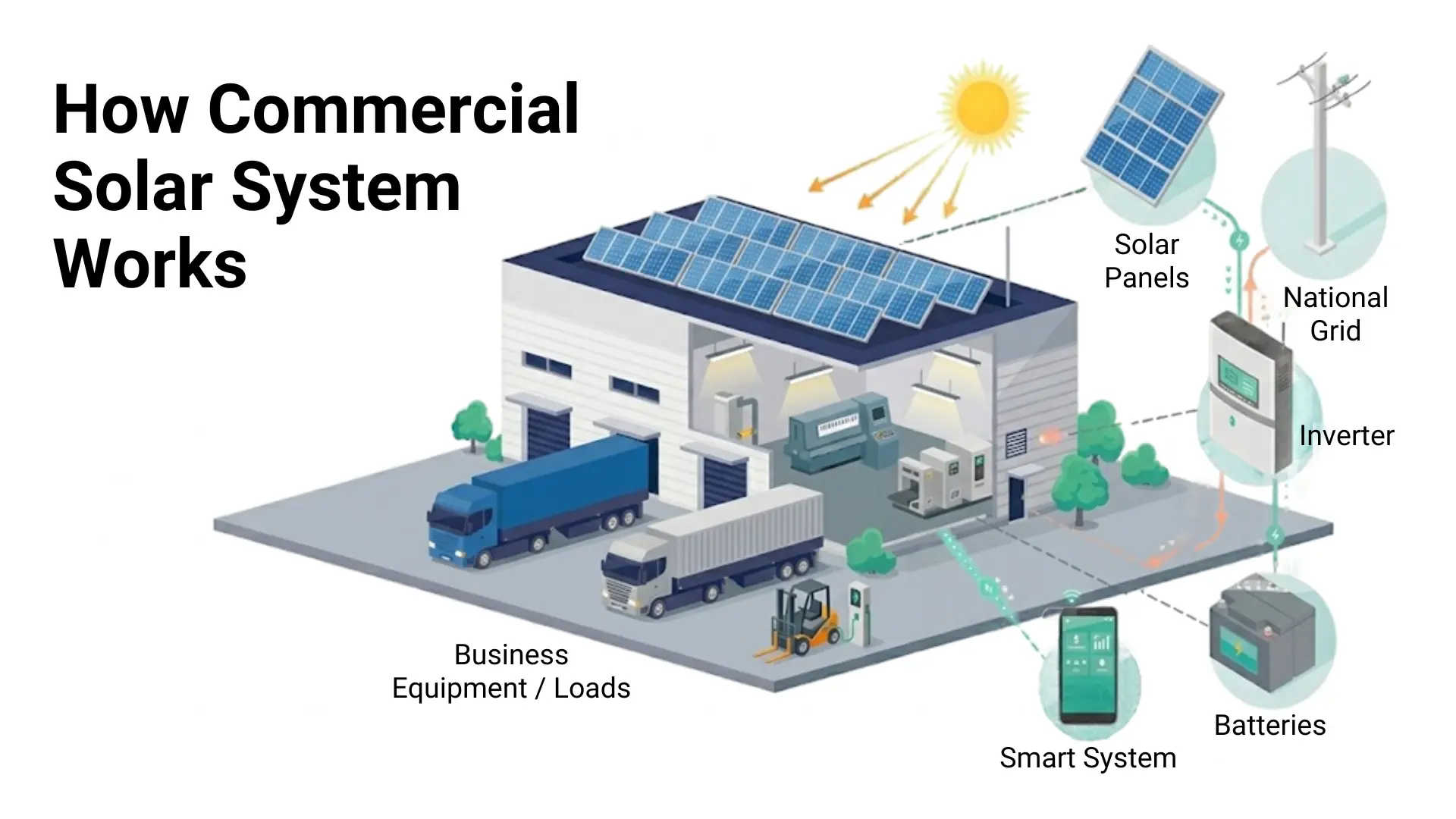
Self-consumption
When your panels generate electricity at the same time your business is using it, solar can replace grid electricity purchases.
This is often the most valuable source of savings because the value of the electricity avoided depends on your applicable grid tariff.
Exporting surplus electricity
When generation exceeds on-site demand, surplus electricity may be exported to the grid. The payment depends on your retailer agreement and connection arrangements.
Export payments are not guaranteed at a particular rate, and network export limits may restrict how much surplus electricity you can send to the grid.
Your financial model should separately identify electricity used on site and electricity exported.
Managing demand charges
Some commercial tariffs include demand charges based on the level of electricity drawn from the grid during specified periods.
Solar may reduce demand charges when it lowers grid imports during the relevant peak period. However, it cannot reliably reduce every peak, particularly when demand occurs early in the morning, at night or during poor solar conditions.
Demand-charge savings should therefore be modelled using your actual tariff and load profile.
What solar will not do
Solar does not automatically eliminate an electricity bill. Your business may still need grid power at night, during low-generation periods or when demand exceeds available solar output.
Actual savings depend on system performance, electricity rates, self-consumption, export arrangements, and changes in future energy use.
5. Is Commercial Battery Storage Worth It?
A commercial battery stores electricity for later use. It can help a warehouse or workshop use surplus daytime solar during the evening, reduce selected grid-demand peaks or supply essential equipment during an outage if the system is designed for backup.
However, batteries add upfront cost and complexity. Solar-only and solar-plus-battery proposals should be compared using the site’s real consumption data.
When a battery may make sense
Consider assessing a battery if your business:
- Has substantial evening or overnight electricity consumption.
- Exports significant solar electricity at a relatively low value.
- Has tariffs with demand charges that a battery could help reduce.
- Needs backup for selected critical equipment.
- Plans to add EV charging or other large loads.
- Qualifies for an incentive that materially improves project economics.
When solar alone may be enough
Solar-only may be the better starting point when most electricity use occurs during daylight hours, surplus exports are limited, and a battery does not provide sufficient additional financial value.
Solar-only vs solar plus battery
| Factor | Solar only | Solar plus battery |
| Upfront cost | Lower | Higher |
| Best suited to | Daytime-heavy loads | Loads extending beyond solar hours |
| System complexity | Lower | Higher |
| Backup during outages | Not normally provided | Possible with suitable design |
| Export reduction | Limited to direct use | Can store some surplus |
| Financial outcome | Depends on self-consumption | Depends on tariffs, use and battery cost |
Compare battery capacity and power
Battery capacity, measured in kilowatt-hours (kWh), describes how much energy can be stored. Battery power, measured in kilowatts (kW), describes how quickly the battery can charge or discharge.
A battery with substantial capacity may still be unsuitable for a large compressor or motor if its power output is insufficient. For industrial sites, both figures and the backup configuration must be checked.
Explore our commercial solar guide and battery storage solutions.
6. Commercial Solar Costs in NSW and the ACT
Commercial solar installation costs depend on system size, panel and inverter selection, roof construction, mounting, electrical upgrades, engineering, site access, monitoring and network requirements.
The following figures were supplied from Solar Choice’s August 2026 commercial price index. They are indicative market averages, not Austar Solar quotations.
| System size | Sydney, NSW | Canberra, ACT |
| 30 kW | $27,920 | $31,360 |
| 50 kW | $49,480 | $47,330 |
| 100 kW | $88,850 | $81,650 |
The figures include the source’s stated certificate-discount and GST assumptions. Actual project costs can differ substantially, so obtain a site-specific quotation.
For additional pricing context, read our commercial solar cost in NSW guide.
What should a commercial solar quote include?
Compare proposals on a like-for-like basis. Check that each quotation clearly states:
- Panel and inverter brands, models and warranties.
- System size and expected generation.
- Roof mounting and any structural engineering.
- Switchboard upgrades and electrical work.
- Network applications, protection equipment and export limitations.
- Monitoring, metering and commissioning.
- Installation safety arrangements.
- Applicable incentives, GST and other charges.
- Workmanship cover, maintenance arrangements and exclusions.
A lower headline price may not represent better value if essential electrical or engineering work has been excluded.
7. Commercial Solar and Battery Incentives in 2026
Several Australian Government and NSW programs may affect the economics of commercial solar. Eligibility depends on the equipment, installation date, project size, site and applicable scheme rules.
Federal Small-scale Renewable Energy Scheme (SRES)
Eligible solar PV systems of up to 100 kW can qualify for Small-scale Technology Certificates (STCs), subject to the scheme requirements.
The rules were expanded for eligible systems from 100 kW to 1 MW installed from 1 October 2026. Applications for certificates under the mid-scale pathway are expected to open in mid-to-late November 2026. Eligible systems in this range have a fixed five-year deeming period. Businesses can review the Clean Energy Regulator’s mid-scale solar guidance.
This change is particularly relevant to larger warehouses and industrial sites that may previously have been above the 100 kW threshold. Certificate eligibility is conditional, and businesses should confirm the applicable rules and certificate pathway before including an incentive in a financial forecast. Source: Clean Energy Regulator.
NSW Batteries for Businesses incentive
Eligible NSW businesses can access an incentive for battery installations from 20 kWh to 30 MWh under the NSW Peak Demand Reduction Scheme.
The program became available from 1 September 2026. The NSW Government indicates that discounts may be around 20–40%, with the amount depending on the project and applicable arrangements. Installing eligible new or additional solar with a battery may increase the discount.
The incentive is generally applied through participating arrangements, and larger projects may require different financial arrangements. Confirm the actual discount and any minimum customer contribution with an eligible provider.
See the NSW Government’s Batteries for Businesses incentive.
Federal Cheaper Home Batteries Program
The federal Cheaper Home Batteries Program supports eligible households and small businesses installing qualifying small-scale batteries connected to new or existing rooftop solar. The discount is generally delivered through the retailer or installer and depends on the eligible battery and current certificate arrangements.
Do not assume that the program covers every large commercial battery. Confirm the current capacity limits, approved equipment, installation requirements and how the program interacts with any NSW incentive before budgeting.
Official information is available from energy.gov.au.
Instant asset write-off and tax treatment
Tax deductions are separate from energy incentives. The instant asset write-off depends on the business’s eligibility, the relevant income-year rules and the cost and use of each asset.
The ATO’s current guidance should be checked before relying on a $20,000 threshold for the relevant year. A commercial solar project may exceed the applicable limit, meaning depreciation or other tax treatment may apply instead.
Ask your accountant about eligibility, GST credits, depreciation, financing and how the project should be treated for tax purposes. Refer to the Australian Taxation Office’s instant asset write-off guidance.
How to compare incentives in a quote
Ask your installer to show the project cost before incentives, each applicable incentive, the final cost, any fees, and the eligibility assumptions. This helps you compare proposals and understand what happens if a certificate value or eligibility decision changes.
8. Worked Commercial Solar Payback Example
The following example is illustrative only. It is not an Austar Solar quotation, guaranteed saving or forecast for any particular business.
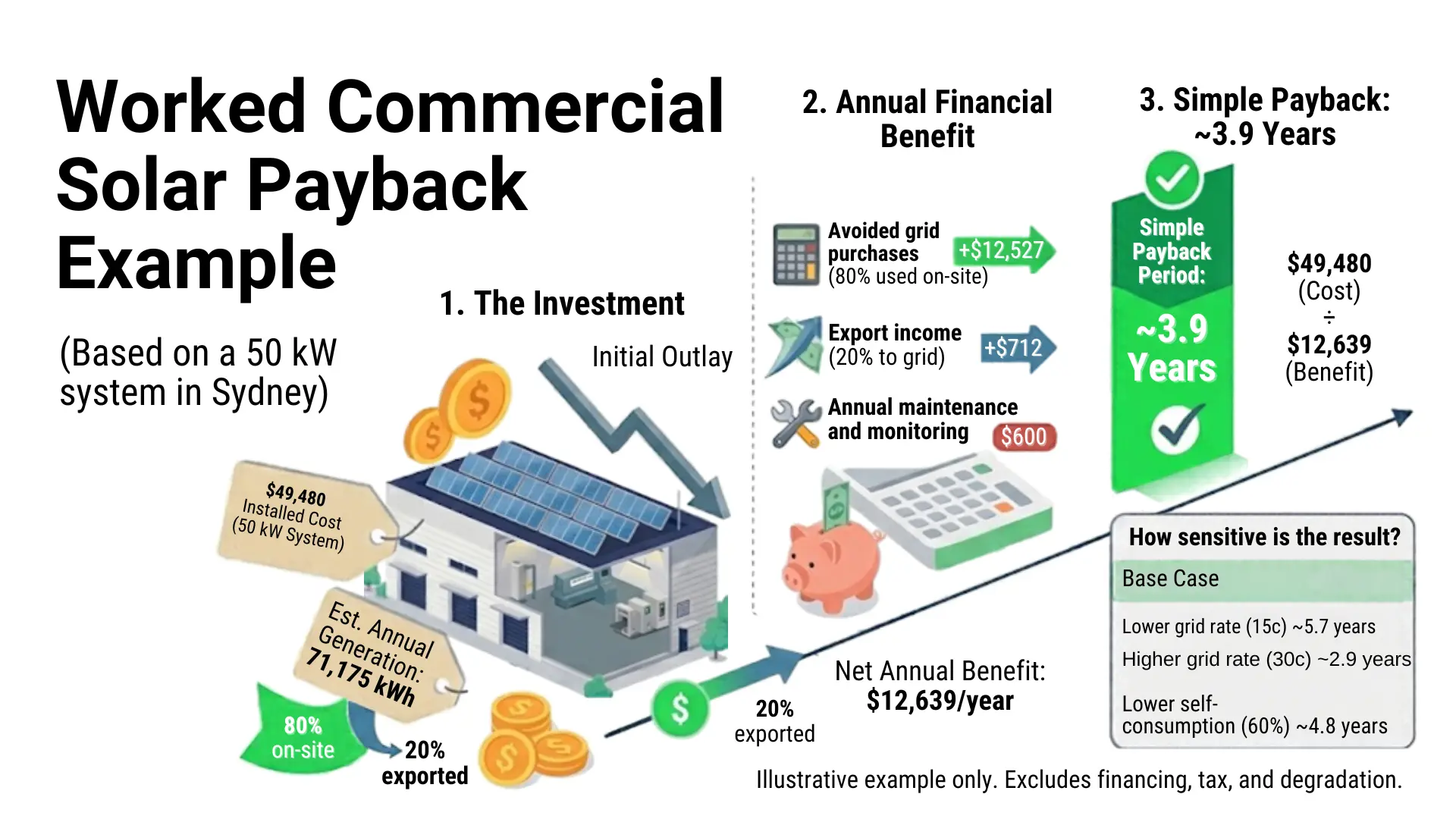
Assume a day-shift workshop in Sydney installs a 50 kW solar system.
| Assumption | Example value |
| Installed cost | $49,480 |
| Average daily generation per kW | 3.9 kWh |
| Estimated annual generation | 71,175 kWh |
| Solar used on site | 80% |
| Solar exported | 20% |
| Avoided grid electricity rate | $0.22/kWh |
| Export value | $0.05/kWh |
| Annual maintenance and monitoring | $600 |
Annual generation is estimated as 50 kW × 3.9 kWh × 365 days = 71,175 kWh.
Estimated annual financial benefit
| Item | Calculation | Annual value |
| Avoided grid purchases | 56,940 kWh × $0.22 | $12,526.80 |
| Export income | 14,235 kWh × $0.05 | $711.75 |
| Maintenance and monitoring | Assumption | −$600.00 |
| Net annual benefit | $12,638.55 |
Simple payback is calculated by dividing the installed cost by the annual net benefit:
$49,480 ÷ $12,638.55 = approximately 3.9 years.
How sensitive is the result?
| Scenario | Net annual benefit | Simple payback |
| Base case: 80% self-consumption, 22c grid rate | $12,639 | 3.9 years |
| Lower grid rate: 15c, other assumptions unchanged | $8,652 | 5.7 years |
| Higher grid rate: 30c, other assumptions unchanged | $17,194 | 2.9 years |
| Lower self-consumption: 60%, 22c grid rate | $10,219 | 4.8 years |
These calculations demonstrate how electricity rates and self-consumption can materially change the result.
The example excludes factors such as financing costs, tax effects, GST credits, seasonal variations, panel degradation, future electricity prices and potential inverter replacement. A proper commercial solar ROI assessment should consider these factors and explain its assumptions. Read our commercial solar ROI and payback guide.
9. Installation Challenges and Approvals
Commercial rooftop solar involves more than installing panels. Early planning can help reduce delays, unexpected costs and business disruption.
Network connection approval
Grid-connected systems must meet the requirements of the relevant network operator. Depending on your location, this may be Ausgrid, Endeavour Energy, Essential Energy or Evoenergy in the ACT.
Larger systems may require detailed technical assessment, protection documentation and specific export limits. Requirements vary by network and system design, so approval should be addressed before installation.
For example, Ausgrid’s solar connection guidance explains how export arrangements and site-specific requirements affect connections.
Switchboard and supply capacity
Your existing switchboard, transformer or electricity supply may limit the size of the system that can be connected. Upgrades or additional protection equipment may be required.
These items should be assessed and included in the proposal before work begins.
Roof repairs, safety and waterproofing
Roof defects may need to be repaired before panels are installed. Mounting methods should suit the roof, and any penetrations must be appropriately weatherproofed.
Commercial sites also require safe work practices around skylights, fragile roof areas, roof edges and operating equipment.
Leased premises and business disruption
If you lease your warehouse, obtain the owner’s written approval and clarify ownership, maintenance responsibilities, savings and arrangements at the end of the lease.
Some installation work may require a temporary shutdown of electrical equipment. Discuss the proposed schedule with your installer so that work can be planned around production, dispatch and other critical operations.
10. How to Choose a Commercial Solar Installer
A reliable commercial solar installation NSW provider should explain the design, expected financial performance, equipment, approvals and installation process clearly.
Before signing, check:
- Accreditation: Verify the relevant designer and installer credentials and any requirements for incentive eligibility.
- Commercial experience: Ask about comparable projects and references where available.
- Site assessment: Ensure the roof, switchboard and electricity data are considered.
- System design: Request an explanation of why the proposed size and layout suit your demand.
- Transparent pricing: Check equipment models, electrical work, network approvals, incentives, GST and exclusions.
- Warranty support: Understand product, inverter, mounting and workmanship cover, including who handles claims.
- Monitoring and maintenance: Confirm what is included and who to contact if performance changes.
- Future flexibility: Discuss whether the design can accommodate planned machinery, EV charging or expansion.
For more information about Austar Solar’s business services, visit our commercial solar installation page.
Frequently Asked Questions
How much does commercial solar cost in NSW?
As an August 2026 market reference, Solar Choice’s supplied price-index figures were approximately $27,920 for 30 kW, $49,480 for 50 kW and $88,850 for 100 kW in Sydney, including the source’s certificate-discount and GST assumptions. Actual prices depend on site conditions and require a project-specific quote.
What size solar system does a warehouse need?
There is no standard size for every warehouse. The right system depends on electricity consumption, operating hours, roof suitability, network requirements and export limits. An installer should analyse interval data and compare several system sizes.
How long does commercial solar take to pay for itself?
Payback depends on installed cost, solar generation, self-consumption, electricity rates, exports, maintenance and applicable incentives. Use a site-specific financial model rather than treating an illustrative example or market average as a promise.
Can a warehouse run entirely on solar?
A grid-connected warehouse generally continues to rely on grid electricity when solar generation is insufficient. Batteries can extend the use of stored solar, but the required storage capacity, power output and backup design depend on the loads that must be supported.
Do I need a battery for commercial solar?
No. Businesses that use most of their electricity during daylight hours may benefit from solar alone. A battery is worth assessing when later loads, demand charges, backup requirements or surplus exports justify the additional cost.
Are commercial solar incentives available in 2026?
Eligible systems may qualify for federal solar certificates, including the expanded SRES pathway for eligible 100 kW–1 MW systems installed from 1 October 2026. Eligible NSW businesses may also qualify for battery incentives. Check current scheme requirements and project eligibility before relying on any incentive.
Do I need network approval for commercial solar?
Grid-connected systems must meet the relevant network operator’s connection requirements. Larger systems may require additional technical assessment, protection arrangements or export limits. Your installer should explain the process and responsibilities before installation.
Do I need council approval to install solar on a warehouse?
Planning requirements depend on the property, installation design, heritage status and applicable state or local rules. Do not assume every project is exempt. Ask your installer to check the requirements with the relevant authority or council.
Can I install solar if I lease my warehouse?
Yes, subject to the owner’s approval and any other applicable requirements. Agree in writing who owns the system, who maintains it, how the savings are allocated and what happens when the lease ends.
What happens to surplus solar when the warehouse is closed?
Surplus electricity may be exported if the connection permits it, with payment determined by your electricity agreement. Because export value may be lower than avoided grid costs, weekend closures should be included in the system-sizing calculation.
Is commercial solar in the ACT different from NSW?
The core technology is similar, but network requirements, electricity tariffs and available programs can differ. The relevant network operators are Evoenergy in the ACT and Ausgrid, Endeavour Energy or Essential Energy in NSW.
Is Your Warehouse Roof Ready for Solar?
Commercial solar can be a valuable long-term investment when the system is matched to the building, operating schedule and electricity demand. The key is to understand the roof, use real consumption data, compare system sizes and assess incentives without assuming a particular saving or payback.
Austar Solar can help businesses in NSW and the ACT assess their commercial solar requirements and consider suitable system options.
Conclusion
Commercial solar can help warehouses, workshops and industrial businesses across NSW and the ACT reduce electricity costs and improve long-term energy efficiency. However, the best results depend on choosing the right system size, assessing roof conditions, understanding electricity usage and meeting network connection requirements.
Before investing, compare solar-only and solar-plus-battery options, review installation costs and payback estimates, and check eligibility for available 2026 incentives. A detailed site assessment and transparent financial forecast can help you make an informed decision based on your business’s energy needs.
Austar Solar supports businesses in NSW and the ACT with commercial solar solutions tailored to their facilities and electricity consumption. Contact Austar Solar for a commercial solar assessment or free quote to explore suitable options for your warehouse or workshop.