The cost of installing solar panels in Australia has dropped significantly over the past decade, largely due to government incentives. One of the most important incentives available to homeowners and businesses is the Small-scale Technology Certificate, also known as the STC rebate.For residents in New South Wales (NSW), the STC scheme provides a substantial discount on the upfront cost of solar installations. By generating certificates based on the expected energy output of a renewable energy system, the scheme allows solar installers to offer immediate savings on solar panel systems.In 2026, the STC rebate remains the largest solar incentive available across Australia, helping thousands of households switch to renewable energy and reduce electricity costs. This guide explains how the STC rebate in NSW works, how much you can save, eligibility requirements, and how to claim the incentive for solar panels and battery storage.
These rebates can significantly reduce installation costs, making solar systems far more affordable for Australian households.However, the STC scheme gradually decreases each year and is expected to phase out by 2030, which means the rebate amount will continue to decline over time.
 One of the biggest solar incentive developments in recent years is the extension of STC-style rebates to home battery systems for the first time. The program launched on 1 July 2025 and is fully active in NSW in 2026 — but with a major structural change kicking in from 1 May 2026.
What Are Small-Scale Technology Certificates (STCs)?
STCs are tradeable certificates issued by the Australian Government as part of the Small-scale Renewable Energy Scheme (SRES). When you install an eligible renewable energy system — solar panels, a battery, a solar water heater, or a heat pump — you earn a set number of certificates based on how much energy your system is expected to generate or displace.One STC = one megawatt-hour (MWh) of renewable electricity generated or displaced. Each certificate carries a capped market value of $40 (excl. GST), set by the federal government.Rather than claiming the money yourself, most NSW residents assign their STCs to a CEC-accredited installer, who passes the value on as an upfront discount off your system price. No paperwork, no waiting — it’s built into your quote.How STC Values Are Calculated
STC values fluctuate based on market supply and demand, as well as the scheme’s annual step-down. Each year, the number of STCs a system can create decreases slightly, meaning rebate values reduce over time. For this reason, installing solar sooner generally provides better rebate outcomes.The number of Small-scale Technology Certificates (STCs) for a solar system is calculated using this formula:Number of STCs = Postcode Zone Rating × Deeming Period (years remaining until 2030) × System Size (kW).To estimate the total STC rebate, you simply multiply the number of STCs by the current price of each certificate:STC Rebate = Total STCs × Price per STC.For example, if you install a 6.6kW solar system in Sydney (Zone 3), the zone rating is 1.382, and the remaining deeming period is 5 years (2026-2030). Using the formula: 1.382 × 5 × 6.6 = approximately 46 STCs.If the current market value of one STC is $40, the estimated rebate would be: 46 × $40 = $1,840.So, a 6.6kW solar system in Sydney could receive around $1,840 in STC rebates, which helps reduce the upfront cost of installing solar panels.| Solar Zone 3 (Average Sunlight) Solar Zone factor of 1.382 | |||
| System size | Amount of STC’s | STC Price | STC Incentive |
| 8.8 kW | 61 | $40 | $2,440 |
| 10.56 kW | 73 | $40 | $2,920 |
| 13.2 kW | 91 | $40 | $3640 |
| 19.3 kW | 133 | $40 | $5,320 |
The Deeming Period in 2026: Why Timing Matters More Than Ever
The number of STCs your system earns is primarily driven by the “deeming period” — the number of years remaining until the scheme ends on 31 December 2030.As of 1 January 2026, the deeming period is 5 years — down from 6 years in 2025, representing an immediate 16.6% reduction in your STC entitlement compared to last year.This is not a one-time adjustment. Each year on 1 January, the deeming period drops by another year, and so does your rebate. By 2027, it will be 4 years. By 2028, just 3. The scheme doesn’t renew.| Year | Deeming Period | STC Impact | Action |
| 2026 | 5 years | 16.6% less than 2025 | Act now |
| 2027 | 4 years | 20% less than 2026 | Reduced savings |
| 2028 | 3 years | 25% less than 2027 | Further reduced |
| 2029 | 2 years | 33% less than 2028 | Minimal value |
| 2030 | Phase-out | Scheme ends Dec 31 | No rebate |
Factors That Affect the STC Rebate Amount
Several factors determine how many STCs your solar system generates.Solar System Size
The larger your solar system, the more electricity it produces and the more STCs it generates.For example:- A 6.6kW solar system typically generates around 45–47 STCs
- A 10kW solar system may generate 70 or more STCs
Installation Location
Australia is divided into different solar zones based on sunlight levels. Regions with more sunlight generate more STCs.Most areas in New South Wales fall under Solar Zone 3, which provides strong certificate generation compared with other parts of the country.Year of Installation
The STC scheme uses a “deeming period,” which decreases every year until the program ends in 2030.This means systems installed earlier receive more certificates than systems installed later, making early adoption more beneficial.How Much Is the STC Rebate in NSW in 2026?
The value of STCs fluctuates depending on market demand but generally ranges between $35 and $40 per certificate.The total rebate amount depends mainly on the size of your solar system. Larger systems generate more certificates because they produce more electricity.Below are approximate rebate estimates for common solar system sizes in NSW.| Solar System Size | Estimated STC Rebate |
| 5kW Solar System | ~ $1,080 |
| 6.6kW Solar System | ~$1,500 – $1,800 |
| 10kW Solar System | ~$2160 |
Major Change: The Cheaper Home Batteries Program in 2026
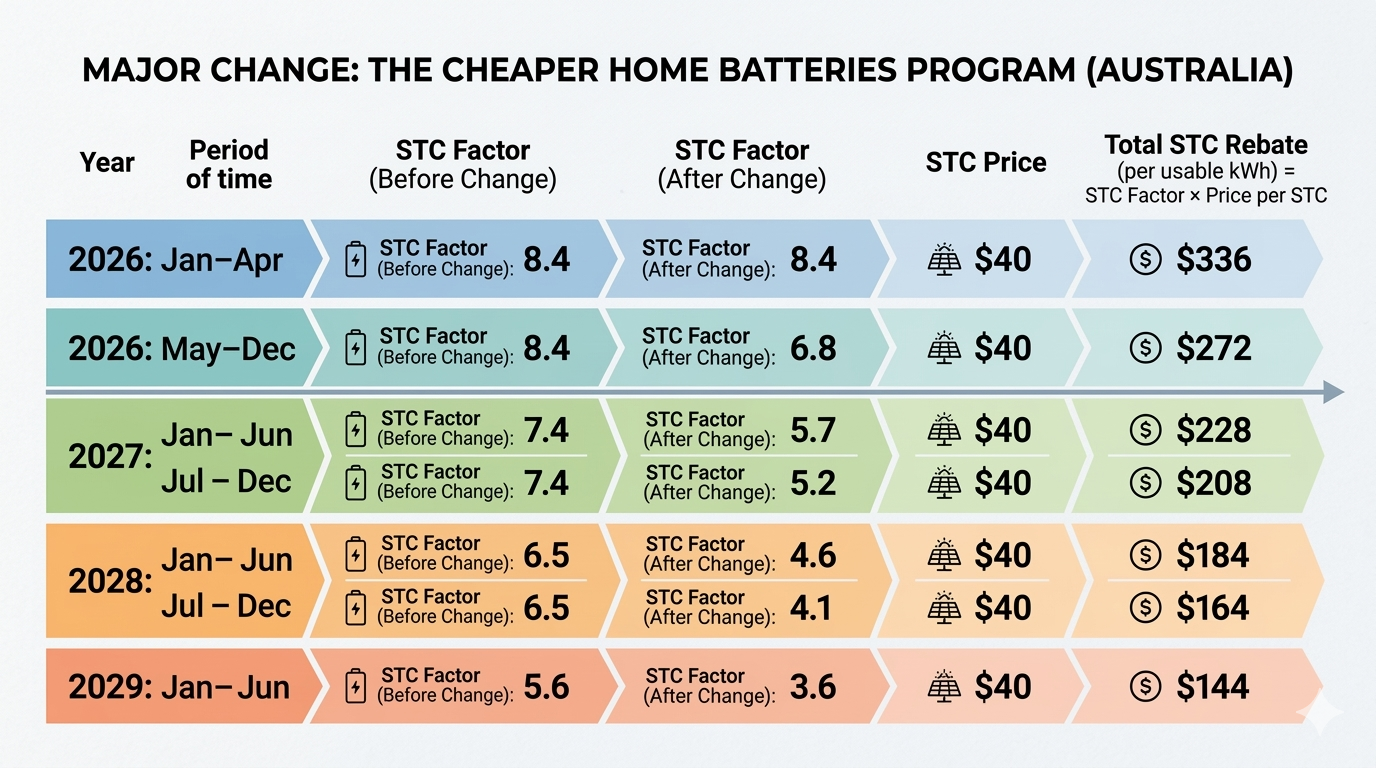 One of the biggest solar incentive developments in recent years is the extension of STC-style rebates to home battery systems for the first time. The program launched on 1 July 2025 and is fully active in NSW in 2026 — but with a major structural change kicking in from 1 May 2026.
Before 1 May 2026 (Higher Rate)
Batteries installed before 1 May 2026 benefit from the highest rebate available under this program. The STC factor is calculated at the full rate, with no tapering based on battery size. For a standard 10kWh home battery, this can translate to approximately $3,000 in upfront savings.From 1 May 2026 (Tiered Tapering Applies)
From 1 May 2026, a new tiered framework applies to all battery STC calculations:- 0–14 kWh of usable capacity: 100% of the STC rate (full rebate)
- 14–28 kWh: Only 60% of the STC rate applies to capacity above 14 kWh
- 28–50 kWh: Only 15% of the STC rate applies to capacity above 28 kWh
| Year From | Period of time | STC Factor (Before Change) | Proposed STC Factor (Already Executed) | Price per STC | Total STC Rebate (per usable kWh) = STC Factor × Price per STC |
| 2026 | Jan – Apr | 8.4 | 8.4 | $40 | $336 |
| 2026 | May – Dec | 8.4 | 6.8 | $40 | $272 |
| 2027 | Jan – Jun | 7.4 | 5.7 | $40 | $228 |
| 2027 | Jul – Dec | 7.4 | 5.2 | $40 | $208 |
| 2028 | Jan – Jun | 6.5 | 4.6 | $40 | $184 |
| 2028 | Jul – Dec | 6.5 | 4.1 | $40 | $164 |
| 2029 | Jan – Jun | 5.6 | 3.6 | $40 | $144 |
| 2029 | Jul – Dec | 5.6 | 3.1 | $40 | $124 |
| 2030 | Jul – Dec | 4.7 | 2.6 | $40 | $104 |
| 2030 | Jul – Dec | 4.7 | 2.1 | $40 | $84 |
NSW Battery Incentive: Virtual Power Plant (VPP) Program
On top of the federal battery rebate, NSW homeowners with a new battery can access the state’s Virtual Power Plant (VPP) incentive. This program rewards households for connecting their battery to the grid during peak demand periods — helping stabilise the NSW electricity network while putting money back in your pocket.The incentive value is based on your battery’s usable capacity, and scales as follows:- 5 kWh battery: ~$275 incentive
- 10 kWh battery: ~$550
- 20 kWh battery: ~$1,100
- 27+ kWh battery: Capped at $1,500
Advantages of Solar Rebate in NSW, Sydney
Solar rebates in New South Wales make switching to solar energy more affordable and financially rewarding for homeowners. These government-backed incentives are designed to reduce installation costs and encourage the adoption of clean energy. Here are the five biggest advantages:1. Lower Upfront Installation Costs
Solar rebate programs significantly reduce the upfront cost of installing a solar power system. This enables more households to access renewable energy without the burden of high upfront costs.2. Reduced Electricity Bills
Generating your own solar power means you rely less on grid electricity. As a result, households can enjoy substantial long-term savings on their energy bills year after year.3. Earn Credits from Excess Power
If your system produces more electricity than you use, the extra power can be sent back to the grid. Energy providers offer credits for this exported electricity, creating an additional financial benefit.4. Incentives for Solar Battery Storage
NSW rebate schemes also support battery installation, making it more affordable to store unused solar energy. Stored power can be used at night or during peak-rate periods, increasing savings and energy independence.5. Increased Property Value
Homes equipped with solar energy systems are more attractive to buyers. Lower running costs and improved energy efficiency can boost resale value and help properties sell faster.How to Claim Your STC Rebate in NSW 2026: Step-by-Step
- Get quotes from CEC-accredited installers only — unaccredited installers cannot create valid STCs.
- Check the approved products list — your panels, inverter, and battery must appear on the Clean Energy Council’s approved list.
- Assign your STCs to the installer — this gives them permission to claim the certificates and pass the discount to you upfront.
- Installer submits the STC claim to the REC Registry — validation typically takes 4–6 weeks, but your discount is instant at the point of sale.
- Apply for the NSW VPP incentive separately — your installer or VPP aggregator will guide you through connecting your battery to the program.